
Sovereign Kaia: Sovereignty Without Isolation

The first article was about how to open up the base layer without losing accountability. The second was about a new kind of user arriving on top of that base, the AI agent. This one zooms out to a different question: what happens when there is no single base at all?
As onchain finance matures, institutions are no longer merely building on existing public chains. They increasingly want their own that they can control. A stablecoin issuer wants to set its own rules. A payments company wants a domain it can certify to a regulator. And the industry already has an answer for it: the sovereign chain. Give every institution its own chain, and connect those chains with bridges. It sounds clean, and that is where the problems begin.
Sovereign chains are necessary. The problem is how they are sold. Most pitches quietly leave out the main cost, which is isolation/ecosystem silo. The moment you split a network into separate domains, liquidity and users fragment, and the bridges meant to reconnect them rarely do the job fully. That part usually goes unsaid.
This article is about the cost that nobody prices in, and about Kaia's answer to it. The answer has two parts. For an institution that wants its own chain, Kaia offers a sovereign chain that does not cut it off from shared liquidity. For the institutions that do not need one, Kaia L1 already provides what they came for. In neither case should the institution have to choose between control and connection.
1. Why institutions want a sovereign chain, and what it quietly costs
Institutions want their own chain: control over the validator set, compliance rules they can certify to a regulator, privacy for transactions that cannot sit in public view, custom fee logic, performance isolation, and predictability. A sovereign chain delivers all of these at once.
It is also a new version of the temptation from Part 1. There, the pull was to narrow the validator set in the name of accountability. Here, it is to take your own chain in the name of control. But this tends to isolate the ecosystem.
What the pitch leaves out is the cost on the other side. Splitting a network into private domains fragments the one thing that made it valuable: a single place where value settles. That is the side effect most sovereign-chain pitches stay quiet about.
It is not a new problem, and it is not specific to Kaia. It may be the most repeated lesson of the last decade in this industry.
Cosmos built the most elegant interoperability in crypto. IBC enables sovereign app-chains communicate years before anyone else managed it, and in 2026 it is going further, with IBC v2 (Eureka) extending beyond Cosmos to Ethereum and other ecosystems. Even so, liquidity still fragmented. Each zone runs its own token and captures its own DeFi value, and little of that value routes back. Excellent interoperability connected the pieces, but it did not keep the ecosystem whole.
Ethereum reached the same conclusion from the opposite direction. The rollup-centric roadmap solved the scalability issue by moving activity to L2s, and it succeeded. It succeeded so well that liquidity is now scattered across more than fifty rollups, with the top three handling roughly 90% of L2 traffic while the long tail struggles. In its 2026 protocol roadmap, the Ethereum Foundation moved L1 back to the center for the first time since 2020, raising the gas limit toward 100 million and backing efforts such as the Ethereum Economic Zone to make the rollups behave more like a single system. This is not failure, and rollups are not going away. It is a correction, and the thing being corrected is fragmentation.
Two very different architectures arrived at the same lesson. Splitting a network is easy. Putting it back together is not. So the real question was never sovereign versus shared. It is whether sovereignty traps liquidity or not.
2. The answers the market has tried
Most of the industry now agrees fragmentation is the problem, and several projects are trying to solve it. Each takes a different route.
Optimism's Superchain is the most direct attempt to make many chains feel like one. It pairs a shared bridge with shared sequencing, so that a transaction on one OP Stack chain can atomically settle a state change on another.
Cosmos is the cautionary tale that still teaches the most. Its interoperability is best-in-class and improving, and fragmentation has persisted anyway, because each sovereign zone keeps its own token and its own value capture. The lesson is not that the technology failed. It is that connection by itself does not create unity.
General-purpose bridges such as LayerZero and CCIP are what most chains rely on when they have nothing native. They are the patch added after the split, they carry the familiar wrapped-asset and mercenary-liquidity problems, and they remain the favorite target of the industry's largest hacks.
Avalanche belongs here too, and Part 1 already covered it. Its L1 model lets each institution run its own sovereign chain, and it pays for that with exactly the fragmentation this article is about. Liquidity and users divide across L1s, and the value that once accrued to the shared layer thins out. It is the camp that gives up the unified settlement layer on purpose.
None of these has fully solved fragmentation, and interoperability on its own has not been enough. That is the problem Kaia set out to solve, and its answer comes in two parts.
3. Kaia's answer: two options
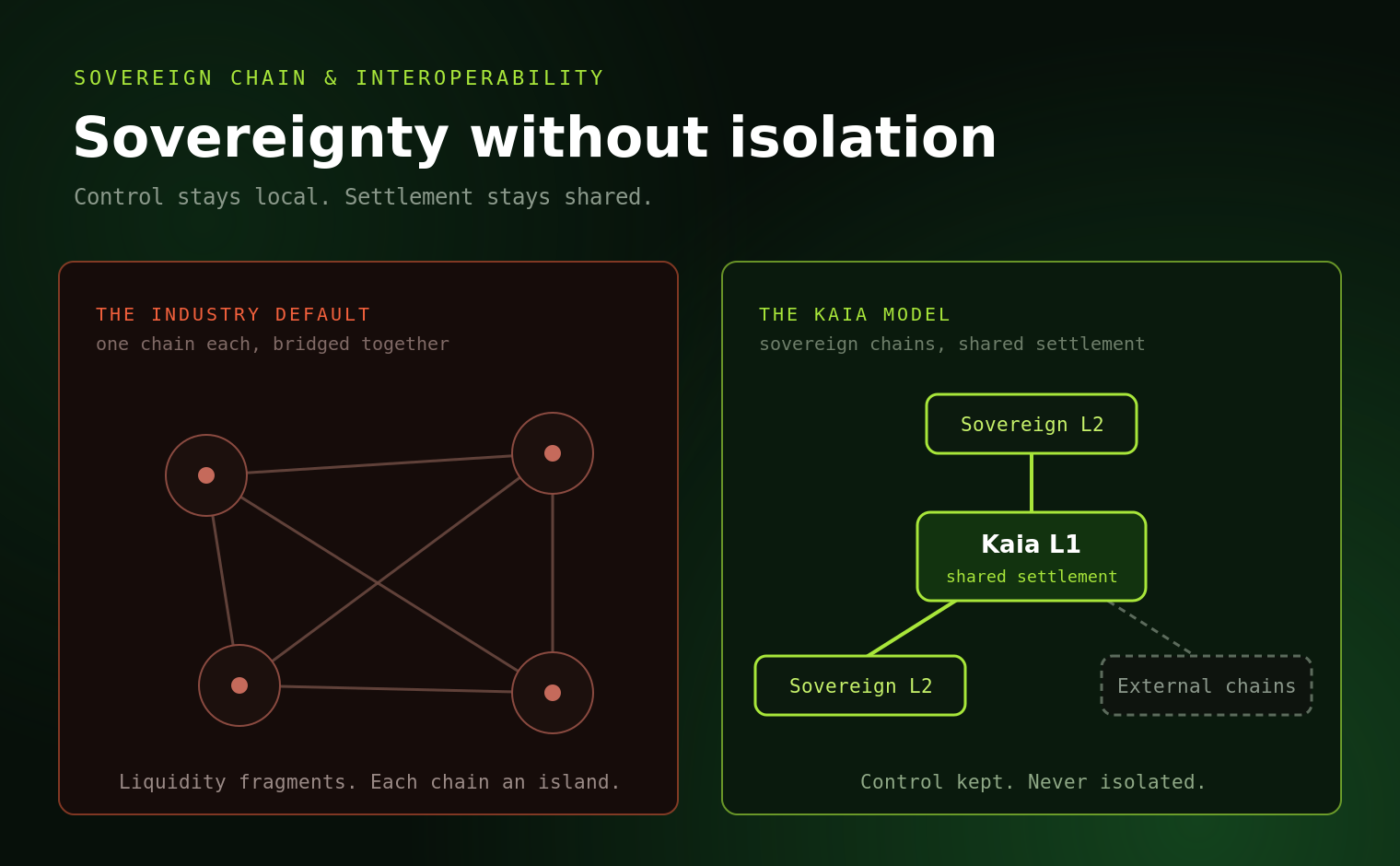
Sovereignty means control. Isolation means trapped liquidity. Most pitches treat them as a single package, but they are not the same thing, and Kaia's approach starts by separating them. An institution can have a genuine sovereign chain without the isolation that has always seemed to come with it.
Path 1: a sovereign chain that is not an island
The clearest way to see this is an arrangement institutions already rely on. A bank runs its own ledger. It controls its own books, sets its own rules, and answers for everything on them. It also settles in central bank money, over a shared rail it does not own. No one asks a bank to move its ledger into the central bank. The two coexist permanently: private control on top, shared settlement underneath.
A Kaia sovereign chain works the same way. The institution gets its own L2, fully under its control, while Kaia L1 and its canonical stablecoins sit underneath as the shared layer. The sovereign chain is the ledger, the stablecoin is the money, and Kaia L1 is the rail they settle on. The structure is hub-and-spoke. Each sovereign L2 is a spoke that keeps its own control, and Kaia L1 is the hub that carries shared settlement and owns the connection to the outside world. Kaia builds the native L2-to-L1 settlement path itself, so an institution never has to stand up its own bridges or bootstrap its own liquidity.
Path 2: Kaia L1 already covers it all
Our new tech roadmap already covers all the features that you need. The first is accountable permissionlessness. The second is scale and reliability: KaiaBFT consensus, one-second finality, and a throughput path toward 10,000 TPS and beyond. The third is compliance and privacy at the base layer. The fourth is agent-ready infrastructure, the subject of Part 2, which provides the rails for the next class of on-chain participants.
Taken together, that covers most of the reasons an institution reaches for its own chain in the first place, and all of it is available without leaving the shared layer. Whether it chooses Kaia L1 or a Kaia-based sovereign chain, the institution lands on the right option for its situation. By default, everything settles together on Kaia L1 instead of fragmenting. And even when a sovereign chain is genuinely needed, its ecosystem never ends up isolated.
Kaia has some standing to make this argument, because it has made the journey itself. It began as a permissioned consortium, a Governance Council built on the Kakao and LINE lineage, and it is now transitioning into a permissionless network, which was the story of Part 1. Few other chains have actually traveled the full path from control to openness. When Kaia tells an institution that sovereignty is a starting point rather than a destination, it is speaking from experience rather than theory.
Whatever an institution needs, Kaia has a path for it. If it wants the shared base with everything already in place, it builds on Kaia L1. If it wants an environment fully under its own control, it takes a sovereign chain on Kaia, connected back to the shared layer by default. The whole spectrum is covered, from a fully shared ecosystem to sovereign chains, and nowhere on it does the ecosystem end up isolated.
4. Interoperability of stablecoins, not the general bridges
Start by changing the question. The industry usually asks how to move tokens between chains. That is commodity work, and it is where many of the biggest hacks have happened. The better question for onchain finance is narrower: what value actually needs to settle across domains? The answer is not a governance token or a yield position. It is the stablecoin.
On Kaia, regional stablecoins exist as canonical assets across L1 and every L2, moved by burning and minting rather than locking and wrapping. There is one asset, one issuer of record, no wrapped copies, and no fragmentation. When a KRW stablecoin moves from an institution's L2 down to L1, it is burned on one side and minted on the other, so what arrives is the canonical asset itself rather than a bridged derivative.
One point stands out here: this fits Kaia especially well. The global dollar stablecoins answer to their issuers: USDC moves canonically because Circle decides it does, and USDT because Tether does. Kaia, as a layer network, does not have control over it. The KRW stablecoin, JPYC, and IDRP are different, because Kaia is the issuance partner for them and can make them native and canonical from the start. So "the stablecoin is the unit of interop" is not a slogan here. It is simply accurate for the assets Kaia is built around.
This is also a case of Kaia moving in the same direction as the rest of the industry rather than against it. The strongest interop designs are converging on one mechanism: canonical assets moved by minting and burning instead of wrapped copies sitting in a liquidity pool. Optimism's SuperchainERC20 works this way, as do Circle's CCTP and the OFT. Kaia is not working against this direction. It is applying the same approach to the asset class that matters most for institutional settlement, regional stablecoins, where it has the issuer relationship to make it real.
Reaching outside Kaia works the same way, through a single door. Kaia L1 is the one hub connecting to other chains, and each sovereign L2 inherits that external connectivity instead of building and securing its own bridges. A mesh of N chains needs on the order of N-squared connections and splits liquidity across all of them, while a hub needs one connection per chain and pools the flow. Because every L2's settlement converges on L1, L1 becomes a center of gravity for liquidity rather than another thin, isolated market. The apparent weakness of a smaller ecosystem becomes a flywheel: the more sovereign chains settle through Kaia, the deeper the shared layer they all draw on.
That said, this approach carries two notable trade-offs. The first is FX across regional currencies. A KRW stablecoin and a JPYC are each canonical, but moving value between them is a foreign-exchange problem rather than a settlement one, and it requires real liquidity and proper price discovery. Kaia is getting ahead of this by incubating an FX engine called Ratio. The second is concentration on the L1. A hub that carries everyone's settlement is, by definition, both a bottleneck and a security target, and Kaia is addressing it with chain-level security hardening, since a hub is ultimately only as good as its resilience.
Wrapping up
Regional stablecoins have real momentum (the KRW stablecoin, JPYC, IDRP, IDRX, MYRC), institutions are actively exploring sovereign environments, and the Asian onchain-finance stack Kaia has been assembling, from Yield8 to the KIP fund, is already in place. The only open question is which architecture absorbs it. And the sovereign path is buildable today.
This is where the series lands. Part 1 opened participation without giving up accountability. Part 2 built the economic body for a new kind of user. Part 3 addressed how capital and liquidity should actually be managed: through a single settlement layer that does not fragment. Kaia L1 is already institutional-grade public-chain infrastructure, and when an institution needs a sovereign chain, Kaia extends it without isolating the ecosystem. Whether an institution builds on Kaia L1 or chooses a sovereign chain on top of it, either way the ecosystem stays connected and unified, never cut off.