
AMA Recap: Unlocking Lending Infrastructure for APAC
Discover how Morpho, Feather, and Redstone are building the next generation of secure DeFi on Kaia. Read our AMA recap to learn about isolated lending markets, robust risk curation, bulletproof oracles, plus exclusive alpha on Merkl rewards.

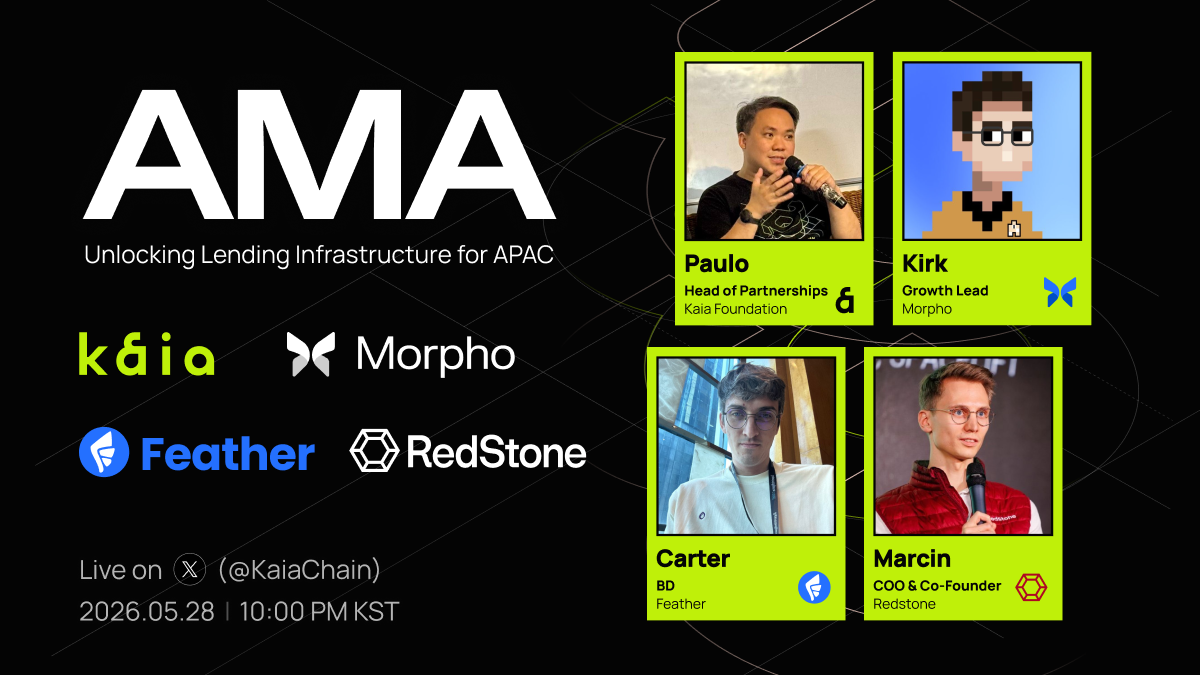
Kaia recently hosted a highly anticipated AMA bringing together three foundational pillars of our growing decentralized finance ecosystem: Morpho, Feather, and Redstone. The conversation offered a deep dive into how these three projects are collaborating to make robust, secure, and user-friendly DeFi a reality on the Kaia network.
By combining Morpho’s innovative lending architecture, Feather’s meticulous risk management, and Redstone’s hyper-reliable data feeds, the Kaia ecosystem is setting a new standard for decentralized borrowing and lending.
Morpho: A Flexible and Immutable Foundation
Kirk, representing Morpho, kicked off the discussion by explaining how their protocol fundamentally redesigns the traditional DeFi lending market. Historically, lending protocols have relied on a "monolithic" structure where all assets are pooled together. In those legacy systems, a vulnerability in a single obscure asset could put the entire protocol's liquidity at risk.
Morpho solves this by utilizing an isolated market architecture. The protocol splits the ecosystem into two distinct sides: lending (managed through Vaults) and borrowing (managed through Markets). Because the code is entirely immutable—meaning not even the Morpho team can alter it or touch user collateral—it provides a mathematically secure base layer. This hands-off approach at the protocol level empowers independent curators to build customized yield products on top of Morpho, making it highly attractive not just for retail users, but for fintechs and institutional players who require strict control over their risk exposure.
 Kaia Marketing Team
Feather: Curating Simple, Solvent DeFi Experiences
Building directly on top of Morpho’s secure foundation is Feather. Carter, the founder of Feather, detailed their dual role as both the user-facing application and the active risk manager. While Morpho provides the unchangeable smart contracts, Feather acts as the curator, deciding which assets are safe enough to be paired together.
1/ 🪶 Feather is LIVE on @KaiaChain
— Feather.zone (@Featherlend) May 14, 2026
With ~$230M in stablecoins onchain + real FX flows and commerce for USDT, IDRX, JPYC ➡️Kaia and Feather (powered by @Morpho ) are set to facilitate onchain credit across the APAC region.
Kaia features:
- Native USDT
- 1 second finality… https://t.co/XV5PTzR55E pic.twitter.com/lxRvJNLbUv
Carter emphasized that Feather’s primary goal is simplicity. Rather than overwhelming users with massive, complex data tables, the Feather interface guides users through a streamlined, step-by-step process to earn yield or borrow against their assets. Currently, Feather supports highly liquid assets on Kaia, including wrapped BTC, wrapped ETH, and stKAIA, with plans to explore additions like the Japanese Yen stablecoin (JPYC).
Crucially, Carter highlighted that their curation process is designed to prevent "bad debt"; situations where a borrower's collateral falls below the value of their loan before it can be liquidated. By actively monitoring onchain liquidity, bridge health, and utilization ratios, Feather ensures that the vaults remain solvent and users are protected from the systemic risks that have plagued older DeFi models.
Redstone: The "Swiss Watch" of Price Data
None of this isolated lending or risk curation would function without perfectly accurate market data, which is where Redstone comes in. Marcin, co-founder of Redstone, explained the immense responsibility of providing oracle services to the DeFi space. Redstone aggregates pricing data from over 400 sources to ensure that the numbers feeding into Morpho and Feather are a true reflection of the global market.
Asia’s super apps are becoming financial infrastructure.@Morpho launching on @KaiaChain means isolated DeFi lending is now plugged into a network reaching 250M+ users across Asia.
— RedStone ♦️ (@redstone_defi) May 22, 2026
RedStone is the oracle layer powering those markets. pic.twitter.com/TT2nOJJiak
Marcin noted that smart contracts are essentially blind logic brackets; they only execute liquidations when an oracle tells them a specific price threshold has been crossed. If an oracle delivers a bad price, wrongful liquidations occur, resulting in massive losses for users. Redstone prevents this through a highly redundant, battle-tested infrastructure that Marcin likened to a "Swiss Watch" for its precision and reliability. He also touched upon Redstone's recent acquisition of Credora, a move that expands their capabilities beyond simple price feeds and into comprehensive risk and credit ratings.
Looking Ahead: Expanding the Ecosystem
The AMA concluded with some exciting alpha for the community and a look toward the future of the Kaia ecosystem. For users looking to jump in immediately, Carter announced that Merkl rewards will be going live in the coming weeks. He also highlighted the incredibly low introductory borrow rates currently available on Feather, allowing users to borrow USDT against BTC for just 0.11% or against ETH for 0.13%.
On the protocol side, Kirk dropped a major announcement: the release of the whitepaper for Morpho Midnight. This upcoming version of the Morpho protocol will introduce fixed-rate lending and borrowing, serving as a powerful companion to their current variable-rate offerings.
Ultimately, the synergy between Morpho’s immutable base layer, Feather’s active curation, and Redstone’s flawless data delivery provides Kaia users with a DeFi experience that prioritizes security without sacrificing yield or usability. With Redstone expanding its support for global FX feeds, Feather exploring new collateral types like JPYC, and Morpho innovating on fixed rates, the infrastructure is primed for rapid growth.