
Introducing KIP: Kaia Investment Partners and the Strategic Roadmap for Onchain RWAs
Introducing Kaia Investment Partners (KIP), a Foundation-owned subsidiary bridging traditional finance with the Kaia ecosystem. Discover how KIP’s new Venture Capital and RWA divisions will drive sustainable onchain utility and real-world value using external LP capital.


Yield in Web3 has historically been a black box. Kaia is changing the paradigm by launching a dedicated, institutional-grade investment arm. Meet Kaia Investment Partners (KIP): the Foundation-owned subsidiary designed to bridge traditional finance with the Kaia ecosystem and drive sustainable, real-world value.
The transition of real-world assets (RWAs) and stablecoin infrastructure to the blockchain requires more than just narrative; it requires structured capital, regulatory compliance, and direct integration with traditional finance. Currently, only the tip of the iceberg in the asset market has been brought onto the blockchain. We aim to build a healthy asset ecosystem by bringing assets with fundamental intrinsic value onchain, and establishing KIP is the first step toward that goal.
KIP is a wholly-owned subsidiary of the Kaia DLT Foundation, operating out of Singapore. Its mandate is straightforward: to act as the comprehensive investment and incubation arm for the Kaia ecosystem, deploying both internal treasury and external capital to drive actual Total Value Locked (TVL) and sustainable onchain utility.
This is a structural shift in how Kaia approaches ecosystem growth, transitioning from a treasury-dependent model to a self-sustaining engine utilizing external capital. By utilizing a fully compliant Singapore Variable Capital Company (VCC) umbrella, KIP creates a clear separation between external venture capital and internal ecosystem funds. This structure provides the legal and operational familiarity required by global liquidity providers (LPs) and traditional financial institutions.
Crucially, all of KIP’s investment capital comes from external LP funds. It does not come from KAIA tokens. This is central to KIP’s identity and is a crucial factor in ensuring the financial independence and expansion of the Kaia ecosystem. This value accrual mechanism enables strategic initiatives, including potential KAIA buybacks.
KIP operates through two primary divisions: the Venture Capital Division and the RWA Division. Here is a detailed breakdown of how each will function and the specific markets they target.
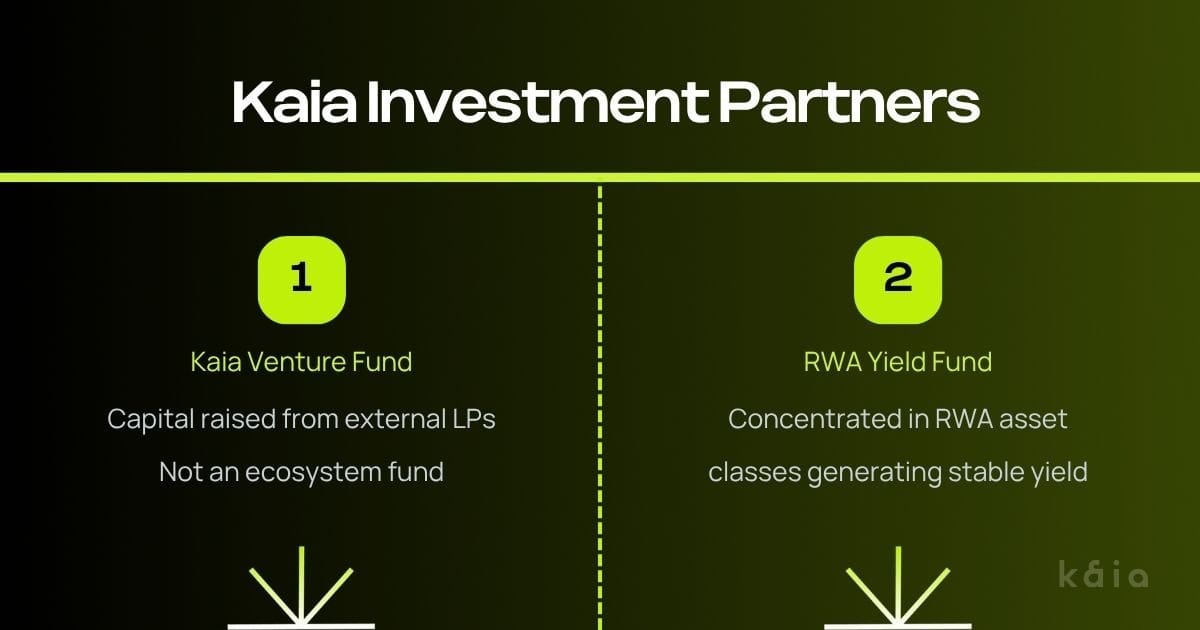
The Venture Capital Division: Stablecoin Mass Adoption Fund I
The stablecoin market has surpassed a $300 billion market capitalization and is projected to scale significantly as it captures global remittance, B2B settlement, and onchain investment flows. To position Kaia at the center of this growth, KIP is launching the Stablecoin Mass Adoption Venture Fund I.
This first venture fund will operate as a Co-GP (General Partner) fund in strategic partnership with Simsan Ventures. While there are ongoing discussions around whether the second fund will also be a co-GP fund or managed solely by Kaia, KIP intends to manage funds independently in the medium to long term. Simsan brings deep-tech investment experience and an extensive network across Europe, the Middle East, and Asia, complementing Kaia’s core infrastructure and distribution capabilities.
The fund targets a 70/30 regional allocation between Asia and global markets. Its investment thesis focuses strictly on projects that build stablecoin utility; spanning payment infrastructure, on/off ramps, yield protocols, and compliance solutions.
Unlike standard ecosystem grants, this is a commercial VC fund. It leverages Kaia’s unique distribution advantage: direct access to over 250 million users via the LINE and Kakao messenger super-apps, to provide exclusive deal sourcing and active value creation for portfolio companies. The goal is to fund the infrastructure that will make Kaia the default routing layer for Asian stablecoin liquidity.
The RWA Division: Kaia Multi-Asset Yield Fund
While the global RWA market has grown to nearly USD 25 billion, it remains heavily concentrated in US Treasury debt (over 70%) and is largely dominated by US capital markets. Asia-based tokenized fund offerings are scarce, presenting a significant first-mover advantage.
The KIP RWA Division is built to capture this gap through the Kaia Multi-Asset Yield Fund. The objective is to transform fragmented, region-specific private credit into tokenized, ETF-like investment products accessible to global investors.
The strategy is phased. Initially, the division focuses on USD-denominated stablecoin strategies to secure early liquidity and scale. Over time, this will expand to local currency-denominated stablecoins (KRW, JPY, IDR) to unlock region-specific yield opportunities.
KIP is collaborating with the Kaia Foundation to carry out the following three tasks within its multi-layered tokenization approach:
- Fund-based Tokenization: KIP structures and manages funds that aggregate diversified yield assets (e.g., the upcoming Yield-8 product).
- Partner-led Token Onboarding: Integrating and distributing tokenized assets issued by Kaia ecosystem partners like Morpho, OpenEden, and Hann Finance.
- Single-Asset Tokenization: Direct tokenization of individual, high-yield assets in private credit and real-world infrastructure.
Ecosystem Synergies and Traditional Finance Integration
KIP does not operate in a vacuum; its RWA strategy is tightly integrated with Kaia’s core DeFi stack. We are creating an ecosystem where stablecoins, RWA assets, and others are brought onto the blockchain and integrated into various DeFi protocols to drive activity.
When local stablecoins are introduced, Ratio will serve as the onchain FX layer, enabling seamless cross-currency settlement. AlphaSec will provide the hedging layer, building perpetual markets for local stablecoins to offer hedging mechanisms for spot-based RWA exposure. Finally, SuperEarn acts as the yield distribution layer, working directly with KIP to offer these localized yield products to end-users.
 Kaia Marketing Team
Beyond Web3 integrations, KIP is actively bridging the gap with traditional finance. In particular, we intend to build this ecosystem in collaboration with prominent financial institutions and asset-holding companies in Asia. The team is currently working on an incubation project involving the tokenization of Hong Kong floating-rate bonds in discussions with major financial institutions. This provides a critical proof-of-concept for indirect tokenization. We have already begun collaborating with various financial institutions in Korea using the model described above, and we plan to expand these partnerships in the future.
The establishment of KIP provides the necessary legal, financial, and strategic framework to move Kaia beyond speculative trading and into real-world capital allocation.
The first tangible output of this framework is KIP's flagship product, Yield-8; a tokenized fund designed to provide users with accessible, stable yields backed by tangible real-world assets. Further details on Yield-8 and its integration with SuperEarn will be detailed in our next update.