
Research Report on Kaia Blockchain and its Mini Dapp Ecosystem (as of May 2025)
This research report was kindly contributed by Kaia Foundation‘s Vivi

This research report was kindly contributed by Kaia Foundation‘s Vivi
1. Executive Summary
This report provides an in-depth analysis of the Kaia Blockchain and its strategic integration with the LINE ecosystem as of May 2025. Kaia Blockchain is a unified platform formed by the merger of Kakao’s Klaytn blockchain and LINE’s Finschia blockchain on August 29, 2024. This merger aimed to create a user-friendly and accessible Web3 ecosystem, leveraging the vast user bases of KakaoTalk and LINE. This report summarizes Kaia’s technical architecture, key application cases, integration with the LINE’s Mini Dapp ecosystem, user adoption, future development plans, and the challenges and opportunities it faces. The analysis indicates that Kaia, through its deep integration with LINE’s Mini Dapp, has established a significant presence in the Asian Web3 space, boasting a large potential user base and a rapidly growing application ecosystem. However, Kaia also faces competition from other established blockchains and uncertainties in the regulatory environment.
2. Introduction to Kaia Blockchain
2.1 Origins of Kaia The Kaia blockchain was born from the strategic merger of Kakao’s Klaytn blockchain and Finschia blockchain, a landmark event that occurred on August 29, 2024. Kakao and LINE, as leading instant messaging application providers in Asia, hold dominant positions in South Korea and Southeast Asian markets, including Japan, Taiwan, Thailand, and Indonesia, respectively. By integrating their blockchain technologies and resources, Kaia aims to build a Web3 environment that is more accessible and acceptable to users, thereby promoting the adoption of blockchain technology in daily life. Unlike many existing Web3 platforms focused on speculation and investment, Kaia’s emphasis is on making blockchain technology practical and relevant to everyday use. This merger represents a significant collaboration between two major Asian tech giants to jointly lead the development of the regional Web3 space. Kaia thus inherited a substantial existing user base, laying a solid foundation for rapid adoption and ecosystem growth.
2.2 Mission and Vision of Kaia Kaia Blockchain’s ambitious goal is to become Asia’s premier blockchain, leading the widespread adoption of Web3 through the integration of the two mainnets, Klaytn and Finschia. Its core vision is to provide a scalable, convenient, and reliable blockchain platform that empowers technological innovation, business development, and individual participation in the Web3 era. Kaia is committed to building a collaborative Web3 infrastructure by combining strong community and infrastructure technologies to discover new opportunities and accelerate innovation. Kaia’s strategic focus is the Asian market, and its deep integration with existing mainstream platforms indicates its aim to seamlessly introduce millions of Web2 users to the Web3 world. This localized strategy may be key to Kaia’s differentiation in the competitive blockchain landscape.
2.3 Key Features Kaia Blockchain is a high-performance public blockchain that is fully compatible with the Ethereum Virtual Machine (EVM). EVM compatibility is crucial for attracting developers and existing Ethereum decentralized applications, streamlining the migration process and expanding Kaia’s application ecosystem. Furthermore, Kaia places a strong emphasis on interoperability with other blockchains, aiming to become an integral part of the broader blockchain ecosystem. User experience and accessibility are core values of Kaia, with the goal of making blockchain technology easy and secure for more people to use without needing to delve into its complex technical details.
3. In-depth Analysis of Kaia Technology
3.1 Network Architecture Kaia Blockchain is a Layer-1 blockchain platform that employs a multi-layered network model, including the Core Cell Network (CCN), the Endpoint Node Network (ENN), and the Service Chain Network (SCN). The Core Cell Network is responsible for transaction validation and block creation, the Endpoint Node Network handles API requests and service integration, and the Service Chain Network supports specific decentralized applications (dApps). This three-tiered architecture is designed to optimize the functions of different aspects of the blockchain, thereby improving performance and scalability. For example, having a dedicated layer for handling API requests can enhance the responsiveness of dApps interacting with the blockchain.
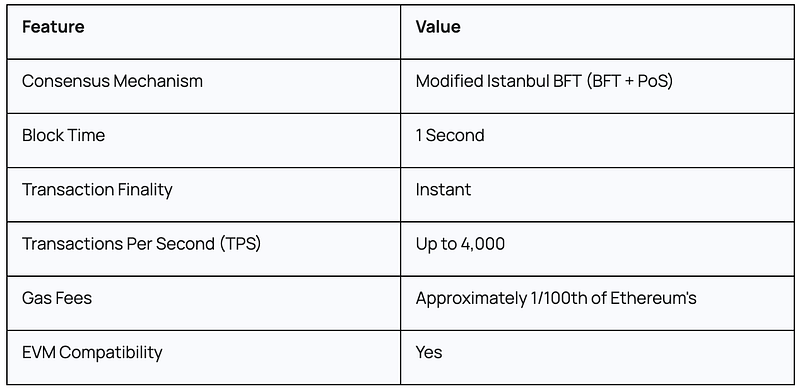
3.2 Consensus Mechanism Kaia Blockchain utilizes a modified Istanbul Byzantine Fault Tolerance (IBFT) consensus mechanism, which incorporates features of both BFT and Proof-of-Stake (PoS). Validators are responsible for verifying and confirming transactions within designated time slots. To ensure fairness and security in block generation, Kaia employs a Verifiable Random Function (VRF) to randomly select a proposer every second. The PBFT-based consensus mechanism ensures network security and smooth operation even if some nodes are malicious or offline, which is crucial for maintaining network integrity and user trust.
3.3 Transaction Speed and Fees Kaia Blockchain achieves a block time of 1 second and instant transaction finality, capable of processing up to 4,000 transactions per second (TPS). Additionally, Kaia’s gas fees are extremely low, approximately one-tenth of Ethereum’s (these figures reflect design specifications; actual performance may vary). Kaia also employs a dynamic gas fee model, maintaining low transaction costs under normal conditions. The high transaction speed and low fees are significant advantages for Kaia, making it suitable for various application scenarios that require near real-time responsiveness and high throughput. As of May 28, 2025, Chainspect data shows Kaia’s real-time TPS at around 45.30.
3.4 Scalability Kaia Blockchain is designed as a high-performance public blockchain. Its predecessor, Klaytn, was capable of handling up to 4,000 TPS. Beyond technical scalability (TPS), Kaia’s strategic focus is on expanding user adoption through deep integration with popular messaging applications in Asia. This strategy aims to leverage the vast existing user bases of LINE and KakaoTalk, addressing the user acquisition challenges faced by many emerging blockchains. Kaia is also exploring modular client structures to further enhance scalability.
3.5 Security Kaia Blockchain employs a PBFT-based consensus mechanism to ensure network security. Furthermore, it implements multi-signature validation, randomized proposer selection, separation of validator and reward keys, and a transparent verification process. These multi-layered security measures indicate Kaia’s strong commitment to protecting the network and its users from potential threats.
Table 1: Key Technical Specifications of Kaia Blockchain
4. Application Ecosystem of Kaia
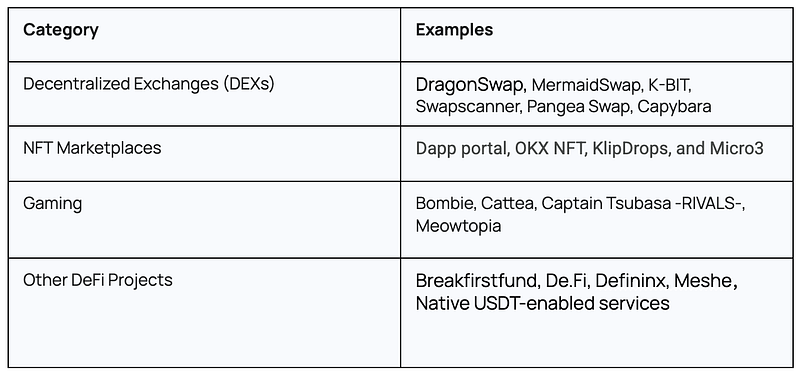
4.1 Decentralized Exchanges (DEXs) Several decentralized exchanges are emerging within the Kaia ecosystem, offering services such as trading and liquidity provision. These include MermaidSwap, a platform integrating DEX, aggregator, games, and profit-sharing features; K-BIT, the first perpetual DEX on the Kaia chain; Swapscanner, aiming to be a one-stop platform and next-generation DEX aggregator for the Kaia ecosystem; Pangea Swap, the first AMM DEX to offer concentrated liquidity on the Kaia ecosystem. DGSwap, the dominant decentralized exchange on the Kaia ecosystem; Capybara,serving as the ecosystem’s primary launchpad for new project IDO.The emergence of these DEXs indicates a growing DeFi ecosystem on Kaia. 1inch Network has also integrated Kaia, providing users with lightning-fast swaps, lower transaction costs, and reliable trade execution.
4.2 NFT Marketplaces Kaia features the Dapp portal, for a public chain ecosystem like Kaia, dApp Portal‘s NFT Marketplace is a critical infrastructure. It lowers the entry threshold for new users, increases the exposure of NFT applications within the ecosystem, and provides an important layer of protection for the security of the entire ecosystem. Users can trade NFTs directly in the LINE applet, achieving a one-stop solution
4.3 Gaming Kaia’s integration with Kakao Games provides access to a diverse portfolio of games. More significantly, LINE NEXT launched Mini Dapps powered by Kaia on LINE Messenger in January 2025, which include several games. Notable games include Bombie and Cattea, Captain Tsubasa -RIVALS-, and Meowtopia. These games often employ a “Play-to-Airdrop” mechanic and NFT-like assets, designed for casual players.
4.4 Other DeFi Projects Besides DEXs, other DeFi projects are emerging on Kaia, such as K-BIT (perpetual DEX), Breakfirstfund (venture capital fund), De.Fi (Web3 super app and antivirus software), Defininx (decentralized multi-chain fund management protocol), and Mesher (a staking 2.0 platform). The appearance of these projects indicates a growing and diversifying decentralized finance sector on Kaia. A significant development is the native integration of Tether (USDT) on the Kaia blockchain in May 2025, which is expected to significantly boost DeFi activity and payment solutions within the ecosystem. Kaia has also launched the Consensus Liquidity (CL) program, allowing users to participate in both validator staking and DEX liquidity provision simultaneously to enhance the ecosystem.
Table 2: Major Application Cases in the Kaia Ecosystem
5. Integration of LINE’s Mini Dapp Ecosystem with Kaia Blockchain
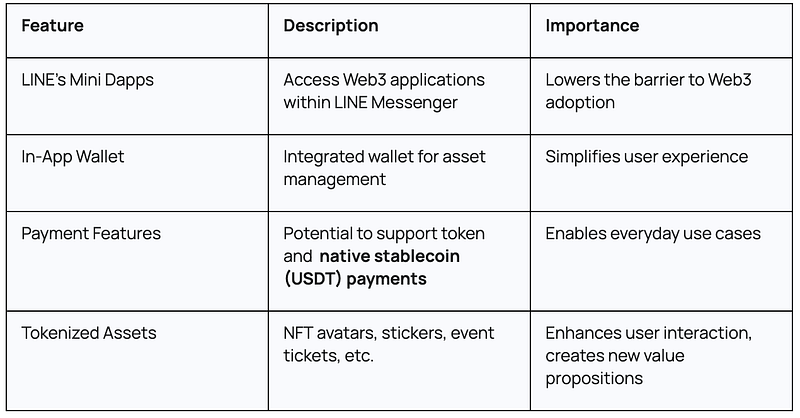
5.1 LINE’s Mini Dapps LINE NEXT launched Mini Dapps powered by Kaia on LINE Messenger in January 2025. These Mini Dapps allow users to access blockchain applications, trade NFTs, and earn rewards directly within the LINE Messenger app without downloading additional applications. Over 75 Mini Dapps were launched initially or added subsequently, with plans to expand to over 1,000 projects by the end of 2025. These Mini Dapps were developed and launched under the Kaia Wave program.
5.2 Use of Kaia Wallet in LINE Users can use the built-in wallet to Mini Dapp within LINE to receive rewards and trade virtual assets and NFTs. Kaia also provides the Kaia Wallet SDK for developers to create LINE’s Mini Dapps with wallet integration features. Integration with third-party wallets like Bitget Wallet for LINE Dapp Portal access was also enhanced in May 2025.
5.3 Kaia Payment Features LINE users can earn tokens directly within the app and exchange them for real-world goods and services. LINE’s payment ecosystem shows significant potential in the blockchain economy. Kaia plans to introduce native stablecoins and integrate them into LINE NEXT’s Web3 wallet; this has been partially realized with the native deployment of USDT on Kaia in May 2025. This will enable LINE’s approximately 196–200 million users to use Kaia-based stablecoins like USDT directly within the LINE app for rewards, payments, settlements, and remittances.
5.4 Other Relevant Integration Features The integration of Kaia with the LINE’s Mini Dapp ecosystem also includes tokenized shopping, where users can earn tokens and redeem them for real-world goods; NFT avatars and stickers, allowing users to create, trade, and customize unique digital collectibles; and tokenized event ticketing, providing on-chain ticketing services for events.
Table 3: Integration Features of Kaia with the LINE’s Mini Dapp Ecosystem
6. User Adoption and Usage of Kaia Blockchain within the LINE User Bases
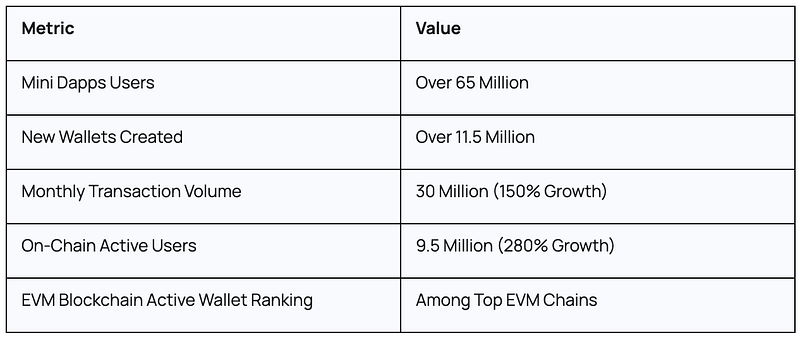
6.1 Growth of Mini Dapps Since the launch of Kaia Wave in early January 2025, Mini Dapps on LINE Messenger powered by Kaia have attracted over 65 million cumulative users by early May 2025. In-app purchases exceeded $3.5 million cumulatively by early May 2025.
6.2 Wallet Creation Over 100 million new digital wallets have been created on the Kaia blockchain since the launch of the Dapp Portal (as of end May 2025). The Dapp Portal alone facilitated the creation of a significant portion of these new wallets.
6.3 Active Users and Transaction Volume As of April 2025, the monthly transaction volume on Kaia increased by approximately 150% (year-to-date or compared to a similar previous period) to around 30 million . On-chain active users grew by approximately 280% to nearly 9.5 million . Kaia continued to rank among the top EVM blockchains in terms of the number of active wallet addresses (specific rank can fluctuate and requires latest data).
6.4 Geographical Distribution Kaia has gained strong user adoption in countries and regions with high cryptocurrency penetration, including Japan, Thailand, Taiwan, and South Korea. LINE Messenger has approximately 196–200 million monthly active users (Original: 196 million; this figure is generally stable) in Japan, Taiwan, Thailand, and Indonesia, while KakaoTalk has a 96% usage rate in South Korea.
Table 4: Key Adoption Metrics and Usage of Kaia Blockchain in the LINE User Base (as of early May 2025)
7. Future Development Plans and Roadmap for Kaia Blockchain and LINE’s Mini Dapp Ecosystem
7.1 Expansion of the Mini Dapp Ecosystem LINE NEXT plans to launch over 1,000 projects by the end of 2025, covering various fields such as games, stores, health and fitness applications, and social metadata platforms.
7.2 Focus on Web3 Payments Kaia has announced Web3 payments as a key focus for future development and has implemented native USDT support, with plans to further integrate stablecoins into LINE NEXT’s Web3 wallet.
7.3 Consensus Liquidity Program Kaia has launched the Consensus Liquidity (CL) program, designed to enhance the Kaia ecosystem by allowing users to participate in both validator staking and DEX liquidity provision simultaneously, thereby increasing economic security and liquidity within the DeFi ecosystem.
7.4 Connection of Real-World Assets (RWAs) Real-world assets such as gold, ships, and real estate already exist on the Kaia blockchain, and there are plans to introduce more fiat-backed stablecoins and bonds. Kaia is also collaborating with IX Swap and LINE NEXT to bring these real-world assets directly to LINE users.
7.5 Technical Enhancements Kaia is committed to continuously improving its scalability and interoperability with other blockchains and is exploring modular client structures.
8. Challenges and Opportunities for Kaia Blockchain and LINE’s Mini Dapp Ecosystem
8.1 Challenges
Kaia faces competition from established blockchains like Solana and Avalanche. To gain broader acceptance in the US market, Kaia needs to navigate regulatory complexities. Ensuring security also becomes a critical challenge with the rapid growth of the ecosystem. Furthermore, maintaining user trust in a nascent financial platform requires time and sustained effort. Scalability will also be tested as the platform gains more traction. Kaia may face potential regulatory hurdles, similar to how Telegram’s wallet feature was excluded in the US. The ambiguity of blockchain and cryptocurrency regulatory frameworks in Asia also poses a challenge. Understanding the complexities of blockchain technology remains an obstacle for mainstream users. Finally, combating potential criminal activities like scams in the crypto space requires constant vigilance and effective measures.
8.2 Opportunities
Kaia’s deep penetration with LINE (approximately 200 million users) and KakaoTalk (with high penetration in South Korea) provides an unparalleled opportunity to introduce a vast user base to the Web3 world. The growing interest in decentralized applications (dApps) and blockchain technology in Asia creates significant potential for Kaia to become a leading Layer 1 blockchain platform in the region. Kaia has the opportunity to bring Web3 to the fingertips of hundreds of millions of users in Asia. Asia’s strong cryptocurrency user base provides a solid foundation for Kaia’s growth.
9. Market Analysis and Expert Opinions
9.1 Market Position
Kaia is the largest Web3 ecosystem in Asia that leverages KakaoTalk and LINE user base. As of early May 2025 , Kaia continued to be a leading EVM blockchain in terms of active wallet addresses in the Asian region. The KAIA token was listed on Bitfinex in March 2025. CoinEx also integrated Kaia in March 2025 to expand Web3 adoption in Asia. Further exchange listings and integrations, including enhanced support for Kaia-native USDT, occurred through May 2025.
9.2 Comparison with Competitors
Kaia faces competition from established blockchains like Solana and Avalanche in the US market. However, the partnership with LINE NEXT provides Kaia with a competitive edge over other projects. Compared to Telegram’s gaming ecosystem, Kakao’s approach shows unique characteristics influenced by Asian gaming preferences. Kaia’s strengths lie in its focus on the Asian market and its strategic partnerships with major regional platforms.
10. Conclusion
As of May 2025 , Kaia Blockchain has made significant progress in the Asian Web3 space through its strategic integration with the LINE’s Mini Dapp ecosystem. Its high-performance technical architecture, growing application ecosystem (notably enhanced by native USDT support), and the vast user bases of LINE and Kakao provide a strong foundation for Kaia’s future development. The rapid adoption and high user engagement of Mini Dapps on LINE Messenger are particularly noteworthy, indicating Kaia’s potential to become a major force in the Asian Web3 landscape. However, Kaia must also proactively address challenges from competitors, uncertainties in the regulatory environment, and the continuous need to enhance user experience and security. Overall, Kaia Blockchain, with its unique advantages and strategic focus, shows great potential in the dynamic and challenging Asian Web3 market.