
PGT Part 3: Shape the Future of Kaia With GP-21 & Performance-Based Tokenomics
In PGT Part 3, we detail the proposed shift from static Proposal Rewards (PR) to a performance-based Contribution Reward (CR) model. By tying inflation to concrete actions like driving TVL and delegation, and burning unallocated rewards, Kaia aims to align validator incentives with network growth.

TL;DR:
Note: This article serves as an introduction to the upcoming GP-21 proposal to gather community feedback before a formal vote.
- The Change: We are proposing to end the static Proposal Reward (PR) and replace it with the Contribution Reward (CR).
- The Mechanism: The portion of block rewards previously allocated as static Proposal Rewards (PR) will now be earned through measurable onchain actions, such as driving TVL and activating delegation.
- The Logic: We are reallocating rewards from a flat-rate model to a performance-based model. This ensures that the 10% of total inflation previously used for PR now directly incentivizes concrete network contributions.
- The Burn: If contributions are low, the unallocated rewards are burned instantly. This introduces a deflationary mechanism to the Kaia network.
- The Goal: Prepare Kaia for a fully Permissionless structure in 2026 by aligning incentives with verifiable ecosystem growth.
- Reduced Costs: As part of the broader Permissionless transition (covered in PGT Part 2), node running costs are expected to drop by approximately 50%, as Governance Council members will no longer need to run a proxy node, only a consensus node.
- Value Creation: The new model ensures that inflation is utilized strictly to fund network growth. This aligns the interests of validators with holders: rewards are only distributed when value is created, benefiting the entire ecosystem.
1. Context: Why Change the "Proposal Reward" (PR)?
Currently, Kaia’s block rewards for the Governance Council are split into two parts:
- Staking Reward (SR - 80%): Distributed based on the amount of KAIA staked.
- Proposal Reward (PR - 20%): Distributed equally to all GCs participating in block generation.
The PR model was designed as a "bootstrap subsidy" for early node operators to secure the infrastructure. Governance Councils have successfully maintained the network during this phase.
Under this model, rewards are allocated uniformly regardless of each GC's contribution to network growth - a structure that served its purpose during the bootstrap phase but has inherent scalability limitations as the network matures. This proposal transitions the reward model from uniform allocation to one that reflects each participant's contribution to network growth.
This proposal represents Phase 1 (Distribution) of a comprehensive three-phase tokenomics reform:
- Phase 1 (Distribution - Now): Shift from static rewards to contribution-based rewards.
- Phase 2 (Supply - Upcoming): Review and optimize the total inflation rate based on the operational data gathered in Phase 1.
- Phase 3 (Demand - Long-term): Implement structural deflation via fee-based buybacks.
We must first fix how rewards are distributed (Phase 1) before we can optimize how many are issued (Phase 2). This ensures that future supply adjustments are based on proven network activity.
This shift is not unique to Kaia; it reflects a broader maturation across the blockchain sector. Leading networks are increasingly moving away from static bootstrap subsidies and adopting dynamic, performance-based reward systems.
2. The Solution: Contribution Rewards (CR)
As we prepare for GP-21, we are introducing the concept of replacing the PR entirely with Contribution Rewards (CR). This is not a live proposal yet, but a starting point for community discussion.
The logic is simple: Value received should be equivalent to value provided.
How CR Works:
Instead of a flat fee, GCs will compete for this reward pool based on core performance metrics that drive network growth and security. While the exact Key Performance Indicators (KPIs) will be finalized in the official proposal, they will generally focus on activities that bring tangible value, liquidity, and active participation to the Kaia ecosystem.
The "Burn" Mechanism
This is the most critical update for KAIA holders.
- Old Model (PR): 100% of the reward budget was distributed every block.
- New Model (CR): If participation is low or targets are missed, the unallocated tokens are burned.
This mechanism ensures that token holders win in either market condition:
- Scenario A (High Activity): Rewards are distributed to GCs who grow the network, resulting in higher TVL and on-chain utility.
- Scenario B (Low Activity): Unallocated rewards are burned, reducing effective inflation and preserving value for all KAIA holders.
The CR mechanism ensures that token issuance is tied to realized network contribution – in either scenario, the outcome strengthens the network's value foundation.
3. Why Now? From Infrastructure to Activation
For the past 6 years, Kaia focused on building infrastructure (1-second block times, instant finality). We have achieved that.
Now, we are entering the Activation Phase. With the integration of RWA (Real World Assets) and deep DeFi integration, we recognize the need for a reward structure that incentivizes Liquidity and Utility, not just node maintenance.
For our existing Governance Councils, this transition creates additional revenue opportunities. First, the structural changes outlined in Part 2 mean node running costs will drop by ~50% (as proxy nodes are no longer required). Second, by actively driving TVL and users, GCs will naturally attract more public delegators. GCs that actively contribute to network growth will have greater earning opportunities under CR, with multiple pathways available – including direct self-stake participation and commission on user delegation.
This transition is also a prerequisite for opening the network to a Permissionless Validator System in 2026. We cannot open the network to hundreds of nodes if we are still using a "flat-rate" reward model, as this would dilute rewards to zero.
4. Community Discussion: The Ratio Options
We are seeking input from the community to decide how aggressive this change should be. Your voice matters in defining the speed of this transition.
Please join the discussion on the Kaia Governance Forum to share your preference.
5. Summary of Benefits
KAIA Holders
- Potential Deflationary Pressure: Unclaimed rewards are burned, protecting token value.
- Value Alignment: Inflation only occurs when value (TVL/Users) is actually added.
Active GCs
- Higher Revenue: GCs that actively participate in CR can earn beyond the current flat-rate PR allocation, with earnings scaling in proportion to contribution.
Builders
- Liquidity: The CR model creates structural liquidity incentives that benefit protocols onboarded in the Kaia ecosystem, as GCs are economically motivated to direct TVL toward qualifying protocols.
Next Steps
This is the beginning of the discussion for the upcoming GP-21 proposal. The proposal is not live yet; we are releasing these details now to foster a broader community discussion around the different options before moving to a formal vote.
To kick off this discussion, we are hosting an X Space AMA to dive deep into the new Kaia governance and tokenomics roadmap. To address the detailed questions from our most active community members, this live session will be conducted in Korean. For our global community, we will publish a full English recap of the Q&A and key insights following the session.
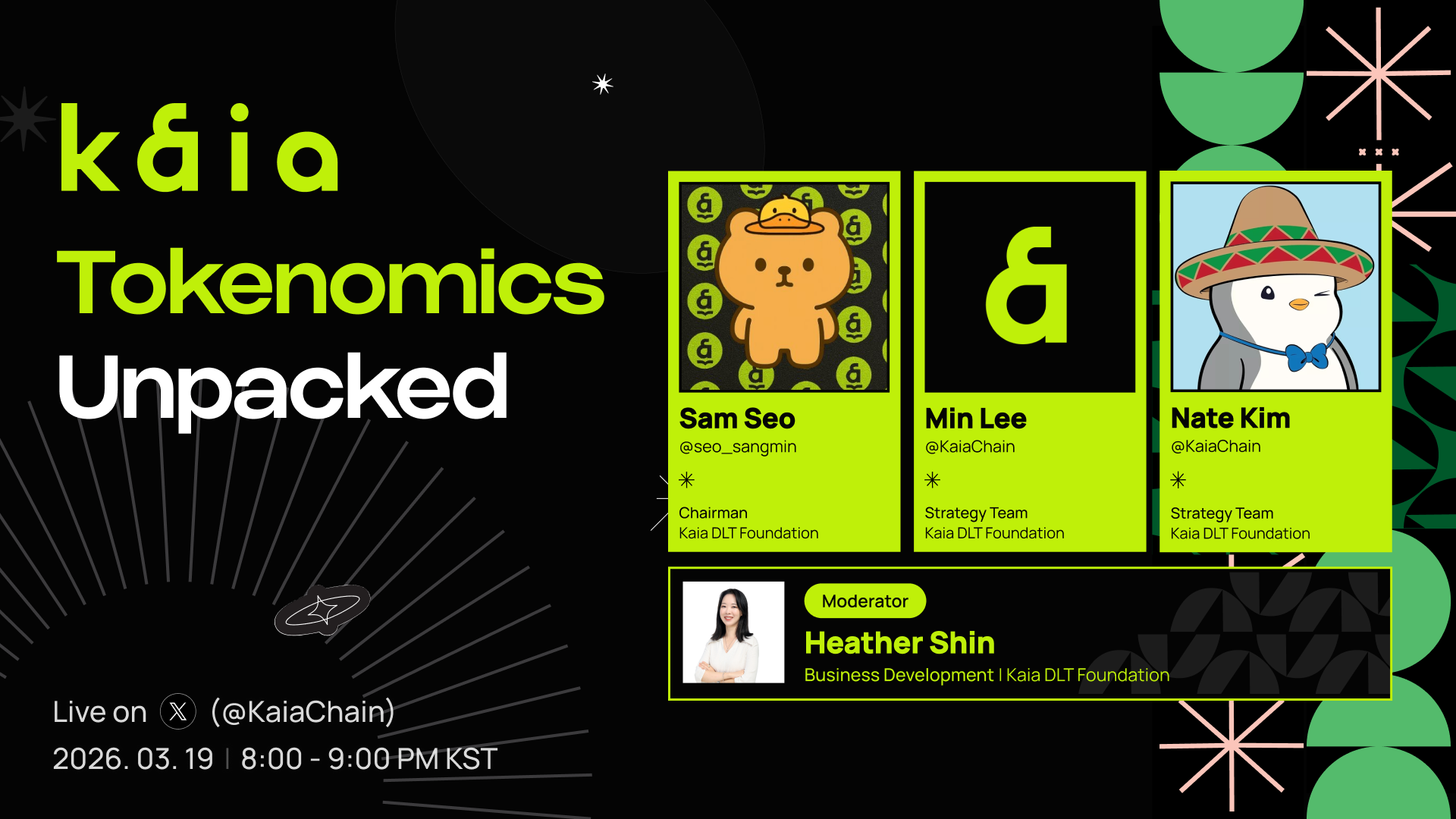
Location: @KaiaChain X Account
Date: 19 March 2026 at 8:00 PM KST
Following the AMA, we invite the community to review the full details on the Kaia Forum and participate in the upcoming governance vote to select the CR Ratio.
Let’s build a Kaia where contributions drive rewards.
Also read: