
PGT Part 1: Kaia’s Structural Transition to a Permissionless & Performance-Based Network
Kaia is evolving from a closed, stability-focused chain into a highly scalable, public Layer 1. Discover the PGT framework, detailing our phased roadmap to open participation, automate governance, and introduce a performance-driven reward structure by September 2026.

TL;DR:
- Transition: Kaia is moving from a Permissioned Governance Council (GC) structure to a fully Permissionless network.
- Framework (PGT): This is a structural redesign involving Permissionless expansion, Governance automation, and Tokenomics reform.
- Core Principle: Participation is open, and the reward structure is evolving. We are transitioning from a single operational reward model to a dual structure that incentivizes both stable network operation and active performance-based value creation.
- Optimized Infrastructure: As part of this transition, Governance Councils (GCs) will no longer need to run proxy nodes. This shift to running only consensus nodes is expected to reduce node operating costs by approximately 50%.
- Timeline: The transition occurs in phases, beginning in April 2026 (Phase 1) and concluding in Late September 2026 (Phase 2).
1. Introduction: The Next Stage for Kaia
Since its inception, Kaia has prioritized network stability through a Permissioned Governance Council (GC) structure. This closed structure successfully established a stable operational foundation. However, to evolve into a true public Layer 1 and a financial infrastructure for Asia, Kaia must move beyond stability toward ecosystem scalability.
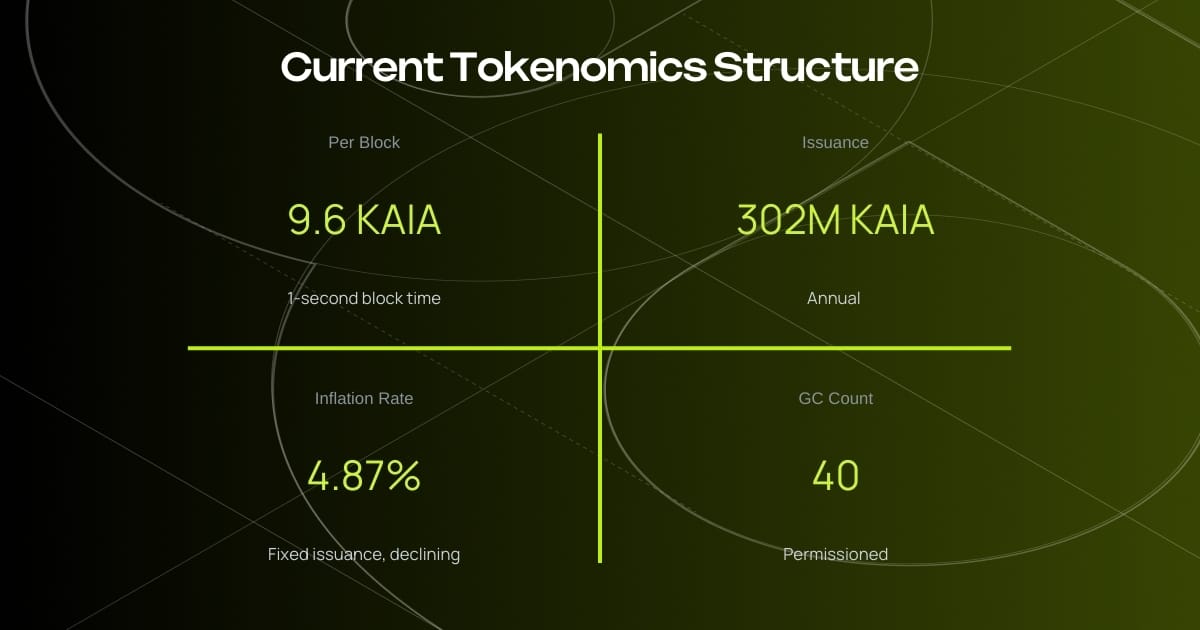
A closed structure imposes a structural cap on growth. If new contributors cannot freely enter, the ecosystem’s value cannot scale. Therefore, Kaia is initiating the transition to a Permissionless structure.
However, simply "opening the door" is not the goal. Open participation without a corresponding performance-based reward structure leads to dilution, not growth.
2. What is PGT?
PGT is the strategic framework for this transition. It stands for Permissionless, Governance, and Tokenomics.
The core philosophy of PGT is that while network stability is foundational, it must be paired with growth.
In the current model, rewards successfully incentivized the stability of node operations. In the PGT model, we introduce a dual-incentive structure: maintaining rewards for secure network operation while introducing new incentives strictly tied to performance and ecosystem expansion.
The PGT feedback loop is designed as follows:
- Permissionless: The network opens to global participation.
- Competition: Participants compete to contribute value (TVL, Transactions, Activity).
- Performance: Contribution is measured via onchain data.
- Reward or Burn:
- Achieved Goals: Rewards are distributed.
- Missed Goals: Unallocated tokens are burned (supply reduction).
This ensures that inflation is directly coupled with value creation. If the network does not grow, the supply does not expand.
3. The PGT Roadmap
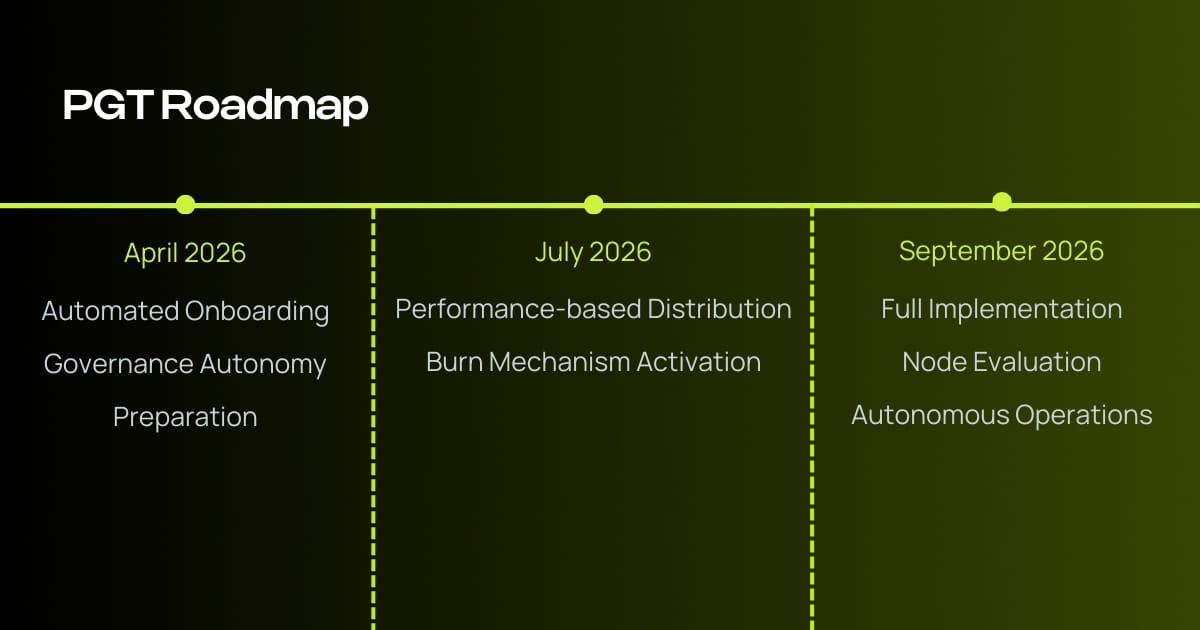
The transition will be executed in two phases to ensure network stability is maintained while openness is introduced.
Phase 1: From Administration to Automation (April 2026)
The first step is removing manual administrative barriers. We are shifting from a "Permission by Application" model to a "Qualification by System" model.
- Automated Onboarding: Introduction of the self-registration system on Kaia Square.
- Governance Autonomy: Removal of manual approval processes for standard operations; registration becomes based on criteria fulfillment rather than permission.
- Preparation: Governance agendas will be proposed this month to codify these rules.
Tokenomics & Governance Improvement (July 2026)
Between Phase 1 and Phase 2, the economic engine will be upgraded. This is the launch of the Contribution Reward (CR) model.
- Implementation of performance-based distribution.
- Activation of the Burn Mechanism for unachieved targets.
- Note: Specific details on the Contribution Reward (CR) model will be shared in a separate proposal (GP-20).
Phase 2: Permissionless Completion (September 2026)
The structural transition concludes. The network becomes fully open, with performance and responsibility inextricably linked.
- Full Implementation: Complete application of the new Validator/Governance policies.
- Node Evaluation: Introduction of a system to guarantee IBFT finality and speed.
- Autonomous Operations: Fully autonomous onboarding and offboarding processes are live.
4. Why This Matters
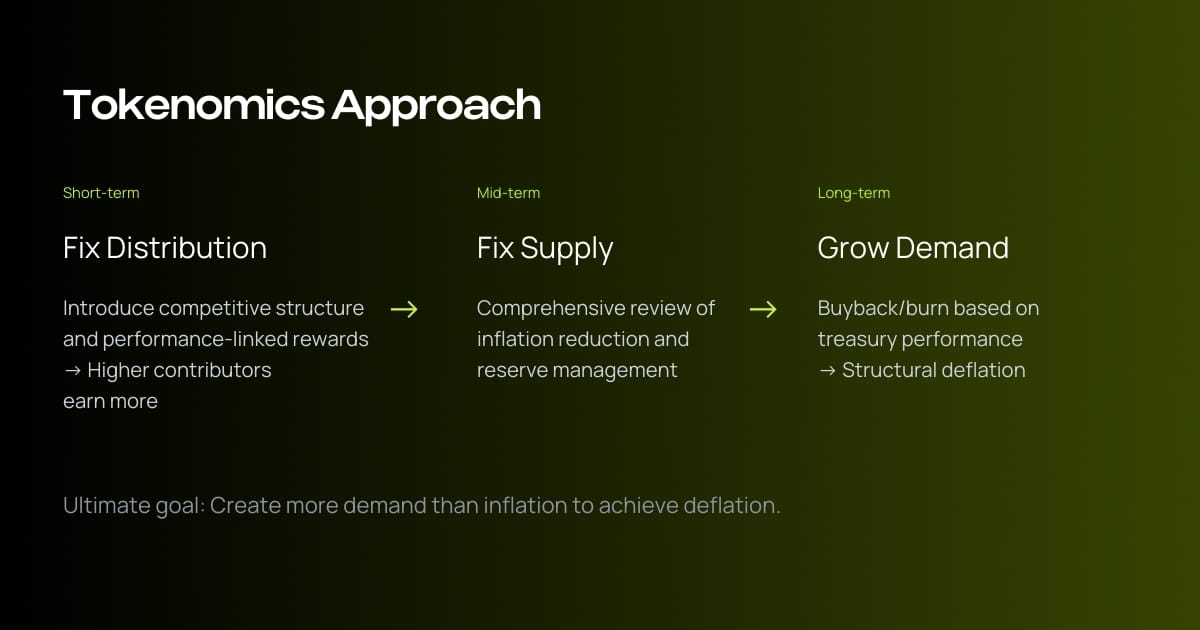
Current tokenomics often separate inflation from utility. PGT unifies them.
By July, Kaia will introduce a mechanism where supply is controlled by performance. By September, the doors will open to any participant capable of driving that performance.
This roadmap transforms Kaia from a "stably operated chain" into a "performance-driven value creation network."
Next Steps
We will be releasing detailed proposals for each component of this roadmap shortly:
- Permissionless Policy & Validator Guidelines (Upcoming)
- GP-20: Contribution Reward (CR) Tokenomics Proposal (Upcoming)
- Tokenomics Expansion Strategy
The Tokenomics reform described in this roadmap represents only the first step. To ensure long-term sustainability and alignment with community expectations, we are reviewing additional strategies, including:
- Deflationary Mechanisms: Further mechanisms that link inflation more directly to network value creation.
- Supply Management: Long-term supply management strategies aimed at potential deflation.
- Protocol Revenue: A sustainable operating model supported by protocol-generated revenue.
PGT serves as the starting point. Beginning with the transition to a performance-based reward structure, Kaia’s tokenomics will continue to evolve through staged improvements.
We invite the community to review the detailed PGT documentation and prepare for the upcoming governance votes.