
Kaia v2.2 Overview
Ethereum Compatibility Work Planned for 2026

Kaia v2.2 is the first major protocol upgrade planned for 2026. The scope is deliberate. It includes no consensus changes and no major architectural redesign. The focus is Ethereum compatibility, plus a small set of protocol features that support later scaling work and wallet UX improvements.
Kaia has not published a full-year 2026 technical roadmap. Beyond v2.2 (which is already taking shape), plans for later releases may change as priorities and implementation details evolve. References to future directions describe intent, not a commitment.
Release plan
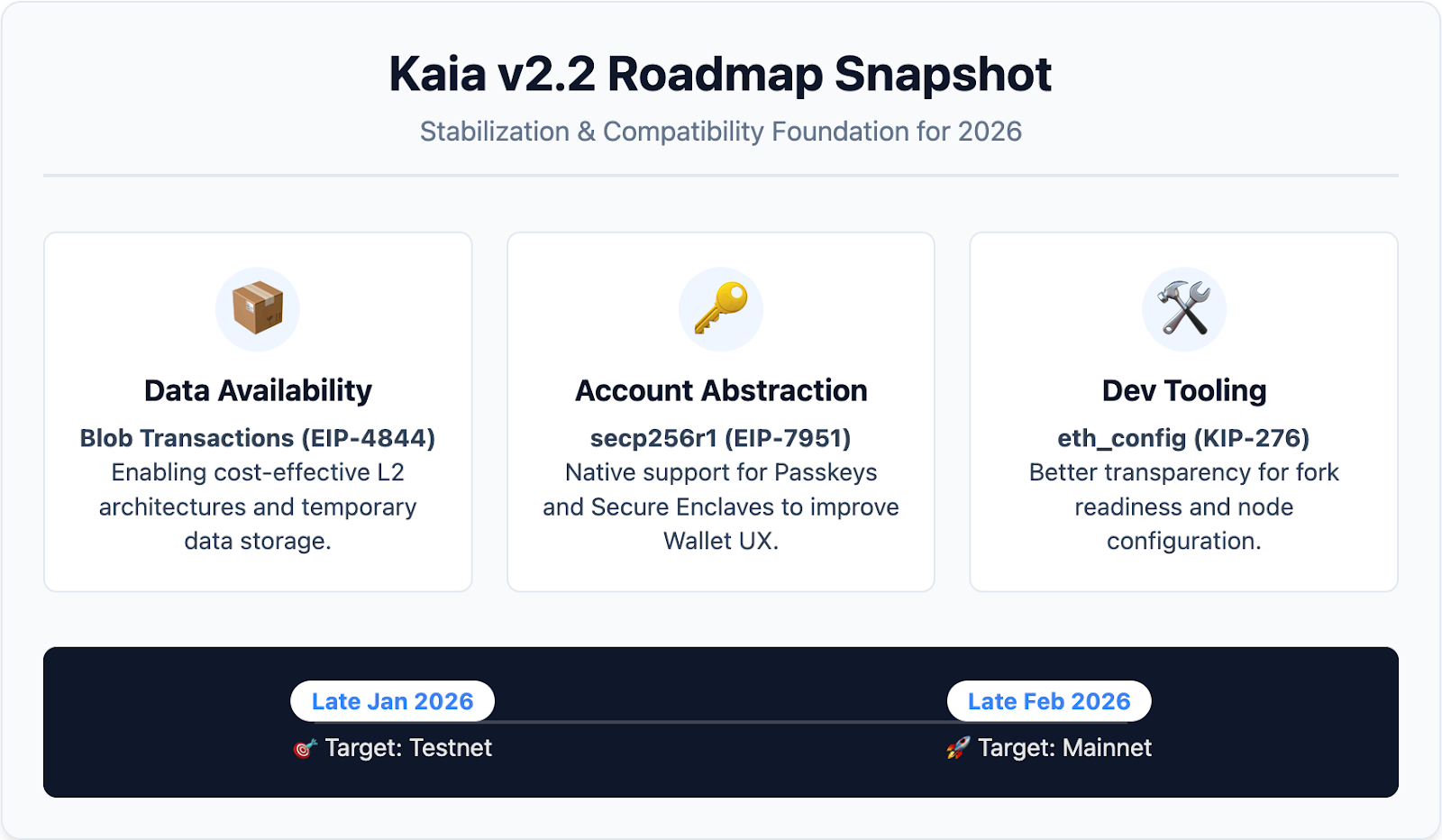
- Testnet: targeted for late January 2026
- Mainnet: targeted for late February 2026
Three compatibility areas
1. Data availability foundation (L2 and sovereignty-style architectures)
In v2.2 scope: Blob Transactions (based on EIP-4844, specified in KIP-279 for Kaia) and other EIPs used in Kaia’s BlobTx specification (notably EIP-7594, EIP-7918, EIP-7516).
Kaia v2.2 adds support for blob transactions, a transaction type that carries data blobs through commitments and proofs. This supports cost-effective, temporary data availability. Ethereum introduced blobs mainly for rollup data availability. Kaia’s goal is to support a wider range of data-heavy systems and L2-style architectures, without placing large payloads into permanently stored calldata.
Kaia-specific implementation (overview)
- Kaia follows the EIP-4844 baseline and adopts the v1 sidecar format (the cell proof version introduced by EIP-7594).
- Kaia does not use Ethereum’s Beacon API framework. Blob sidecars are served through JSON-RPC endpoints, not a Beacon API.
A follow-up article is planned with more detail on KIP-279, including transaction format, sidecars, validation, and cost behavior.
2. Account abstraction enablement (wallet UX groundwork)
In v2.2 scope: a secp256r1 precompile (EIP-7951)
The secp256r1 precompile enables more efficient verification for the ECDSA signatures commonly used by Passkeys (WebAuthn) and secure enclaves on mainstream devices. This supports passkey-based onboarding designs and smart account patterns.
This applies to 1) passkey-first onboarding flows, 2) smart accounts and account abstraction designs (for example, EIP-4337-style approaches), and 3) wallet UX changes that preserve existing security assumptions.
3. Developer tooling parity (hard fork coordination)
In v2.2 scope: the eth_config JSON-RPC method (aligned with EIP-7910, specified for Kaia in KIP-276), plus execution-layer compatibility updates such as ModExp gas-cost alignment (EIP-7823/7883) and other smaller EVM parity changes.
With these compatibility upgrades, operators and tooling providers need a reliable way to confirm which fork is active and which parameters apply. The eth_config method addresses this. Unlike Ethereum's timestamp-based activation, Kaia uses block numbers, so the response does not include an activationTime field.
The “8 yes, 5 no” decisions
When Ethereum’s Osaka/Fusaka upgrade set was finalized, Kaia did not adopt every item by default. Each proposal was evaluated against Kaia’s architecture and ecosystem needs. The result was 8 adopted and 5 declined.
What is not in v2.2
v2.2 is a compatibility and infrastructure release. Several items are out of scope:
- No consensus changes in v2.2
- No permissionless validator change in v2.2
This keeps compatibility work separate from larger consensus or execution redesign efforts.
Kaia may share more about possible next steps after v2.2 as plans become clearer. References to future upgrades are directional and may change.
What this means for different builders
Layer 2 and rollup teams should note that blob transactions are included in v2.2. If your design relies on temporary data availability, pay attention to sidecar handling and tooling support. A later article is planned to cover KIP-279 in detail.
Wallet and account abstraction teams can test Passkey/WebAuthn signature verification flows and smart-account patterns with secp256r1 available.
Node operators and infrastructure providers should plan around the testnet and mainnet targets. Use eth_config in operational checks and dashboards to confirm fork status and parameters.
Looking ahead
While Kaia v2.2 delivers essential Ethereum compatibility updates, it is just the first step in our 2026 plans. Permissionless validation and major performance enhancements are scheduled for subsequent upgrades later in the year.
Next in this series (planned):
- Deep Dive: Blob Transactions on Kaia, unlocking cheaper L2 data availability
- Passkey authentication and Kaia’s secp256r1 precompile
Technical resources: