
Kaia Community AMA Recap: Tokenomics Revision & Contribution Rewards (CR)
The Kaia Foundation's recent AMA detailed the shift to the Contribution Reward (CR) system. Replacing passive node rewards, CR incentivizes DeFi growth by requiring participants to stake Kaia and deposit USDT liquidity. Unmet targets trigger a token burn to ensure real value.

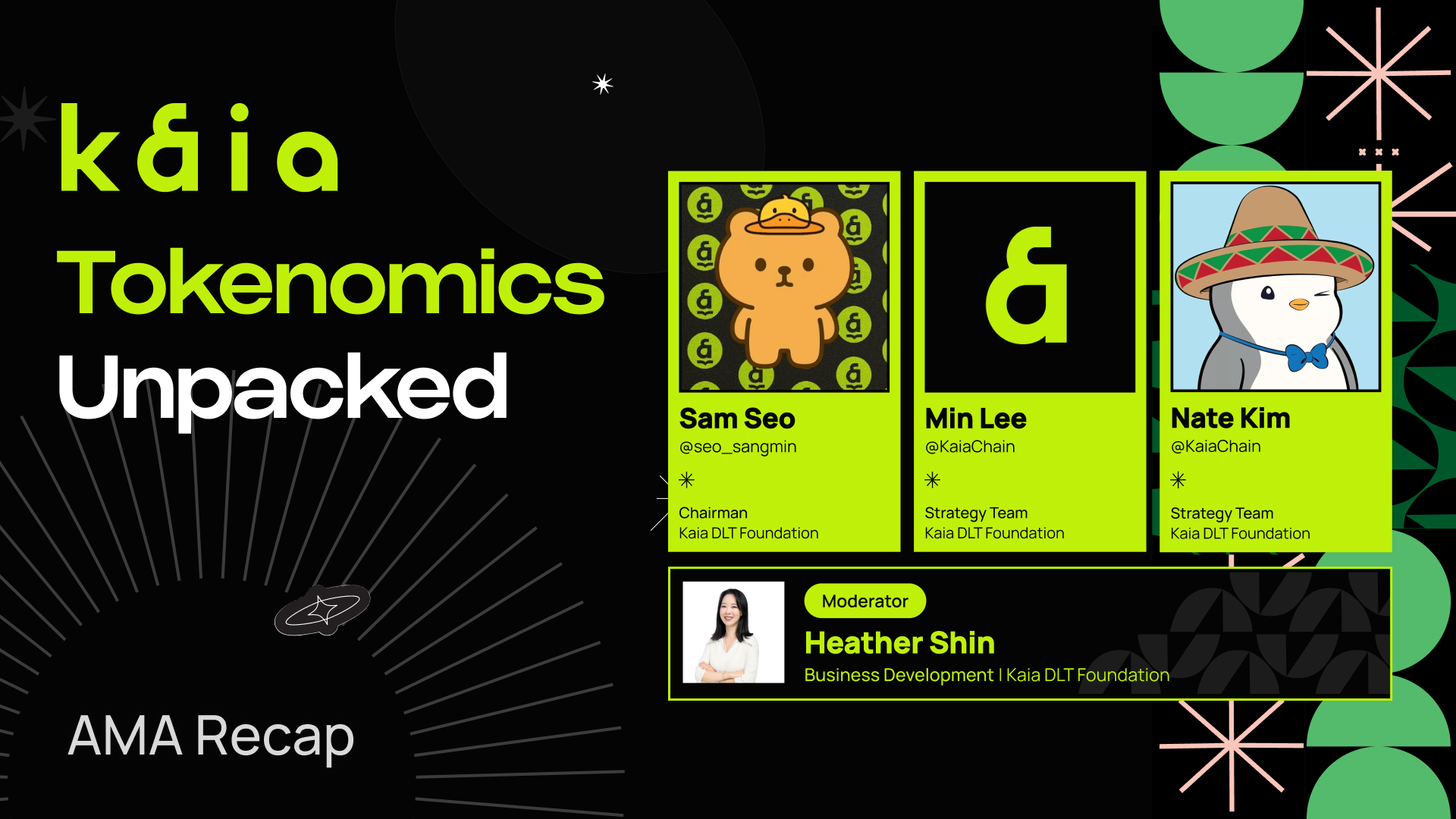
On Thursday March 19th, the Kaia Foundation hosted a live AMA with the community to discuss the upcoming Tokenomics Revision, specifically focusing on the transition to the Contribution Reward (CR) system.
Hosted by Sam (Chairman of the Kaia Foundation), Nate, and Min (Strategy & Operations), and moderated by Heather (Business Development), the session provided a deep dive into how Kaia is restructuring its rewards to build a stronger DeFi ecosystem, alongside an open and honest Q&A session addressing community concerns regarding token price, UX, and the Foundation's long-term vision.
If you missed the live session, here is a complete recap of everything that was discussed.
The Core Proposal: Transitioning to Contribution Rewards (CR)
As Kaia transitions toward a fully permissionless network, the previous Proposal Reward (PR) system, which primarily subsidized node operation costs, is being retired. In its place, the Foundation is introducing the Contribution Reward (CR).
[Upcoming AMA: PGT Framework & Tokenomics]@KaiaChain is hosting an X Space to dive deep into the newly proposed KAIA tokenomics and governance proposal.
— Kaia (@KaiaChain) March 17, 2026
To address detailed questions from our most active community members, this session will be conducted in Korean. pic.twitter.com/8V2XQGT8Pf
The proximate goal of CR is simple: Incentivize the growth of Kaia’s DeFi infrastructure by attracting deep stablecoin (USDT) liquidity.
However, the ultimate objective of CR is broader than that. The core purpose is to establish a competitive reward structure in which contributors are rewarded in proportion to their clear and measurable contributions to the network. The first direction of that broader objective is to drive DeFi growth through USDT liquidity.
How the CR Mechanism Works:
To earn Contribution Rewards, Governance Council (GC) members and delegators must do more than just stake Kaia. They must actively contribute to the ecosystem's liquidity.
- The Requirement: Participants must stake Kaia and deposit USDT into approved onchain protocols.
- The Ratio: The required ratio is 10 Kaia staked for every 1 USDT deposited.
- The Target: The Foundation has set a maximum target of 500 million Kaia staked and 50 million USDT deposited.
- Approved Protocols: Initially, USDT must be deposited into SuperEarn or Unifi to qualify for rewards.
- The Burn Mechanism: If the target metrics are not met, the unallocated token rewards will be burned, creating a deflationary pressure on the token supply.
By tying rewards directly to USDT liquidity, Kaia aims to build the foundational financial infrastructure required for dApps, lending protocols, and broader ecosystem growth.
— Kaia (@KaiaChain) March 16, 2026
Community Q&A Highlights
The second half of the AMA was dedicated to answering direct questions from the community. The Foundation appreciated the candid feedback and addressed several pressing concerns.
Q1: What is the Foundation’s strategy for driving the long-term value and growth of the Kaia token?
Nate & Min: We deeply appreciate the dedication of our long-term holders and share your high ambitions for Kaia’s future. To unlock the true, exponential value of our Layer 1 network, our primary focus is on cultivating a vibrant, high-utility DeFi ecosystem.Right now, over 90% of Kaia's USDT volume sits on centralized exchanges (CEXs) rather than onchain.
Without onchain stablecoin liquidity, developers cannot build lending protocols, DEXs, or other financial products. The CR proposal is our direct strategy to fix this. By forcing GC members and large holders to bring USDT onchain to earn rewards, we are building the liquidity foundation necessary for the Kaia ecosystem to actually grow and generate intrinsic value.
Q2: Why not just burn more tokens or reduce the total supply to boost the price?
Sam: While token burns can create short-term price narratives, they do not create long-term utility. If we just burn tokens without building the underlying DeFi infrastructure, the network will not grow. Our focus is on creating a sustainable economy. The new CR system actually includes a burn mechanism—if the liquidity targets aren't met, the unused rewards are burned. This ensures that tokens are only emitted when real value (USDT liquidity) is added to the chain.
Q3: The UX for buying and staking Kaia is still very difficult, especially within the LINE app. When will this be fixed?
Sam: We completely agree that the UX needs improvement. The ideal scenario is a simple "buy and stake" button directly inside the messenger app. However, strict virtual asset regulations (particularly in Korea and Japan) prevent us from directly integrating fiat-to-crypto purchases inside the app right now. We are actively working on technical and legal workarounds to make onboarding smoother, but navigating these regulatory hurdles takes time.
Q4: Why is the Foundation changing the reward structure instead of reducing its own operational funds (KEF/KIF)?
Sam: CR is being introduced in line with the transition to a permissionless system, where GC members and validators should be able to compete and earn rewards based on their actual contributions. Under the current structure, rewards are distributed equally, which does not create strong enough incentives for participants to make greater efforts or contribute more meaningfully.
The transition to CR is intended to ensure that the tokens we distribute are not used simply to cover node maintenance costs, but are instead directly tied to measurable indicators of ecosystem growth, such as liquidity.
At the same time, we fully understand the community’s concerns. The Foundation is actively reducing operational expenses. If you look at Kaia Square, you can see that our expenditures have already decreased significantly. However, we cannot eliminate essential development and ecosystem support funding entirely, since those are still necessary to continue building and growing the network.
Next Steps
The Foundation outlined the next steps for the Tokenomics Revision:
- Late March / Early April: The final proposal will be uploaded to the Governance Forum, and the official Governance Council vote will take place.
- April - June: If passed, the development and smart contract implementation will take approximately two months.
- July 2024: Target launch for the new Contribution Reward (CR) system.
Closing Thoughts
The transition to Contribution Rewards marks a major shift in how Kaia incentivizes its network. By moving away from passive node rewards and demanding active liquidity contributions, Kaia is laying the groundwork for a robust, DeFi-native future.
We want to thank everyone who tuned in, asked tough questions, and continues to support the Kaia ecosystem. Your feedback is vital as we build a permissionless, highly liquid, and user-centric blockchain.
To stay updated on the upcoming governance vote, make sure to follow our official channels and join the conversation on the Kaia Governance Forum.