
How to use Kaia Toolkit for Platform-level Multisig on Kaia
Author. Peter Ayo (Kaia Foundation DevRel Engineer)

Author. Peter Ayo (Kaia Foundation DevRel Engineer)
Introduction
As Kaia continues its mission to make Web3 accessible and seamless for both users and developers, it is evolving on two powerful fronts. On one hand, Kaia is emerging as a super app blockchain designed for massive adoption. On the other, it is actively delivering developer-first tools that simplify the process of building intuitive and user-friendly decentralized applications.
One such tool is the Kaia Toolkit. The Kaia Toolkit empowers developers to build user-friendly dApps while offering a smooth onboarding path to the Kaia ecosystem. Thanks to Kaia’s full EVM compatibility, the toolkit serves as a bridge for EVM-native developers, allowing them to explore and integrate Kaia’s unique features with no initial coding required.
In this guide, we will walk through how to use the Kaia Toolkit to implement platform-level multisig functionality on Kaia. By the end, you will learn how to create an account using the toolkit, update its key to a multisig account, and perform transactions such as transferring KAIA tokens from a multisig account.
What is Kaia Toolkit
Kaia Toolkit provides code examples and a web application to help developers utilize the Kaia blockchain and its SDK easily. The toolkit serves as both a reference implementation and a practical set of tools for blockchain developers building applications on the Kaia network. This would mean that the usability for both ends of the developer spectrum are considered — seasoned devs will be able to refer to the open-source code on GitHub, and beginners can try out Kaia’s features without having to write any code.
What is platform-level multisig and why should you care?
What is platform-level multisig?
Platform-level multisig refers to a multisignature feature built directly into the account structure of a Kaia Account. On Kaia, this functionality is not added through smart contracts but is natively embedded into the account’s key structure — unlocking a more secure and user-friendly experience.
Traditionally, on Ethereum, an account address is derived from a single private key. This creates a major limitation — if your private key is ever compromised, your account is as good as lost. The best-case scenario involves racing to migrate all your assets to a new address before they are siphoned. And the worst? Losing the new private key as well, forcing you to repeat the painful cycle.
Kaia takes a different approach by decoupling keys from account addresses. Your account address is no longer derived from your private key, which means that even if your key is compromised, your account remains intact. You simply replace the compromised key with a new one and continue operating securely. This key can be updated at any time through an AccountUpdate transaction.
This architecture makes it possible to introduce multisignature logic at the protocol level, without the need for external contracts or third-party tooling.
Enter AccountKeyWeightedMultiSig
One of the key types supported by Kaia is AccountKeyWeightedMultiSig. This allows an account to define multiple public keys, assign each a weight, and specify a threshold required for transaction approval. Each key is assigned a weighted value and a transaction is considered valid only when the weighted values of the signed keys meet or exceed the threshold.
For example, you could configure:
- Three keys: A, B, and C
- Weights: A = 1, B = 1, C = 1
- Threshold: 2
In this setup, any two keys must co-sign a transaction for it to be valid. If one key is lost or compromised, the account is still functional and recoverable — all without migrating to a new address or rewriting contract logic.
Why This Matters
Platform-level multisig isn’t just a technical improvement. It redefines how we think about ownership, control, and safety in Web3. Here’s what it unlocks:
- True Account Recoverability
If a key is compromised, you can rotate it without moving assets or switching accounts. - Elimination of Smart Contract Risks
No need to deploy or audit custom multisig contracts. The logic is built into the account on-chain. - Better UX for Everyone
From seasoned devs to first-time users, platform-native security features lower the learning curve and reduce friction. - Safer, More Resilient Systems
Multisig is no longer a niche feature for DAOs or treasuries. It becomes a default for everyone — individuals, teams, and applications.
Platform-level multisig on Kaia redefines account security by baking multisig directly into its architecture. Say goodbye to fragile key-pairs and say hello to recoverable, flexible, user-first accounts — secured at the core.
Getting started using Kaia Toolkit for Platform-level Multisig
In this section, we’ll walk through how to test Kaia’s platform-level multisignature feature using the Kaia Toolkit. You’ll learn how to create a new account, update it into a multisig-enabled account, and execute a transaction using multiple keys — all in just a few steps.
Under the hood, this experience is powered by the Kaia SDK, which includes extensions for major frameworks such as ethers-ext, web3js-ext, web3j-ext, and web3py-ext. These libraries provide developers with seamless access to Kaia’s protocol-level features, including its advanced account key structure.
Step 1: Navigate to the Kaia Toolkit Multisig Page
Visit the AccountKeyWeightedMultisig section of the Kaia Toolkit. This interface allows you to interactively create and configure multisig accounts without writing a single line of code.
Step 2: Prepare an account
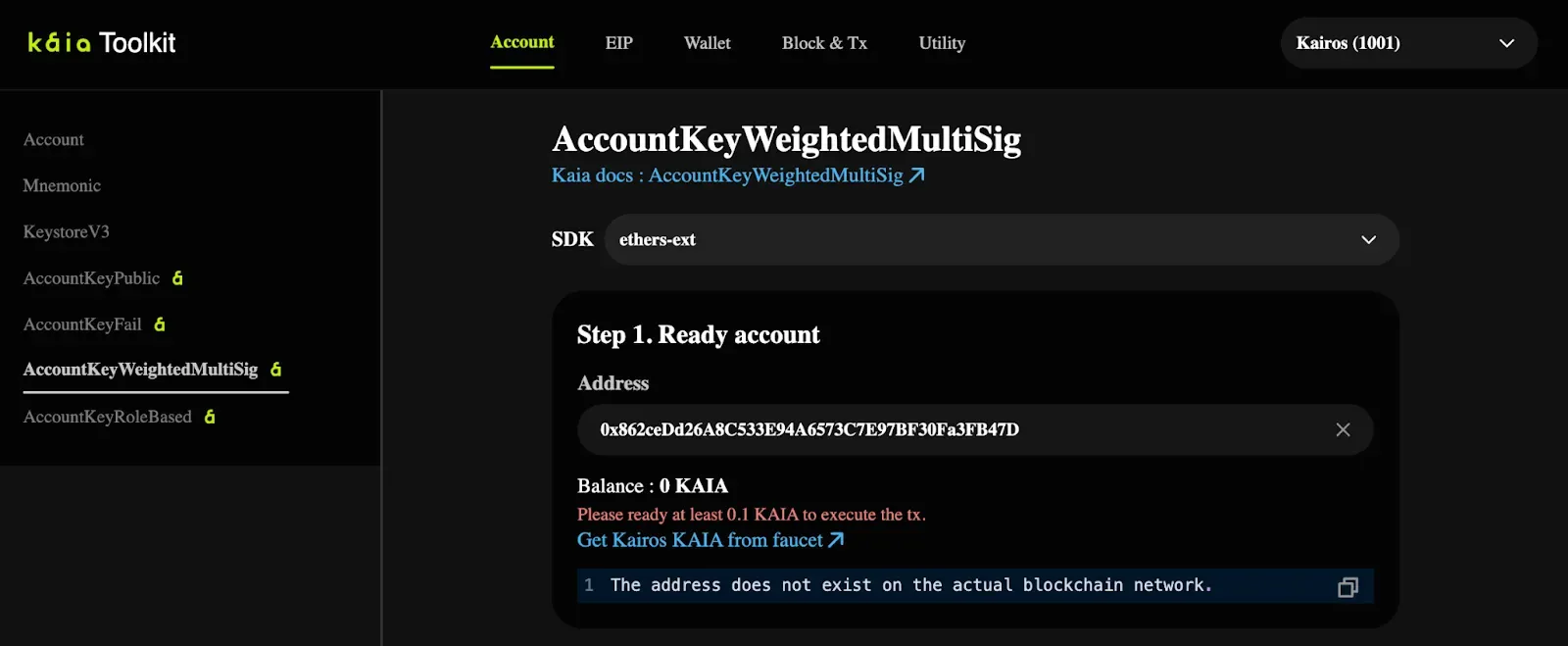
Begin by generating a new Kaia account that will later be upgraded to a multisig-enabled account.
- Click on the Generate button.
- A new account address and private key pair will be displayed.
- Fund your new account with test KAIA tokens by following the instructions provided on the Toolkit interface.
> Important:
Make sure to save your private key securely. This will be required for signing transactions later in the guide.
Step 3: Update to accountKeyWeightedMultisig.
Next, we’ll upgrade your account to use the AccountKeyWeightedMultisig key type. This key structure allows you to assign weights to multiple keys and define a signing threshold for validating transactions.
How It Works
Each key is assigned a numeric weight. To authorize a transaction, the sum of the weights of the signing keys must meet or exceed the threshold.
Example Scenario:
- Keys: A, B, C
- Weights: A = 1, B = 2, C = 3
- Threshold: 3
Valid signing combinations:
- Key C alone (3)
- Keys A and B (1 + 2 = 3)
- Keys A and C (1 + 3 = 4)
- Keys B and C (2 + 3 = 5)
- All three keys combined (1 + 2 + 3 = 6)
Our Configuration
For this guide, we will:
- Generate three keys: A, B, and C
- Assign each key a weight of 1
- Set the threshold to 2
This means that any two keys must be used together to validate a transaction.
- Click the generate button to generate a private key for each private key field.
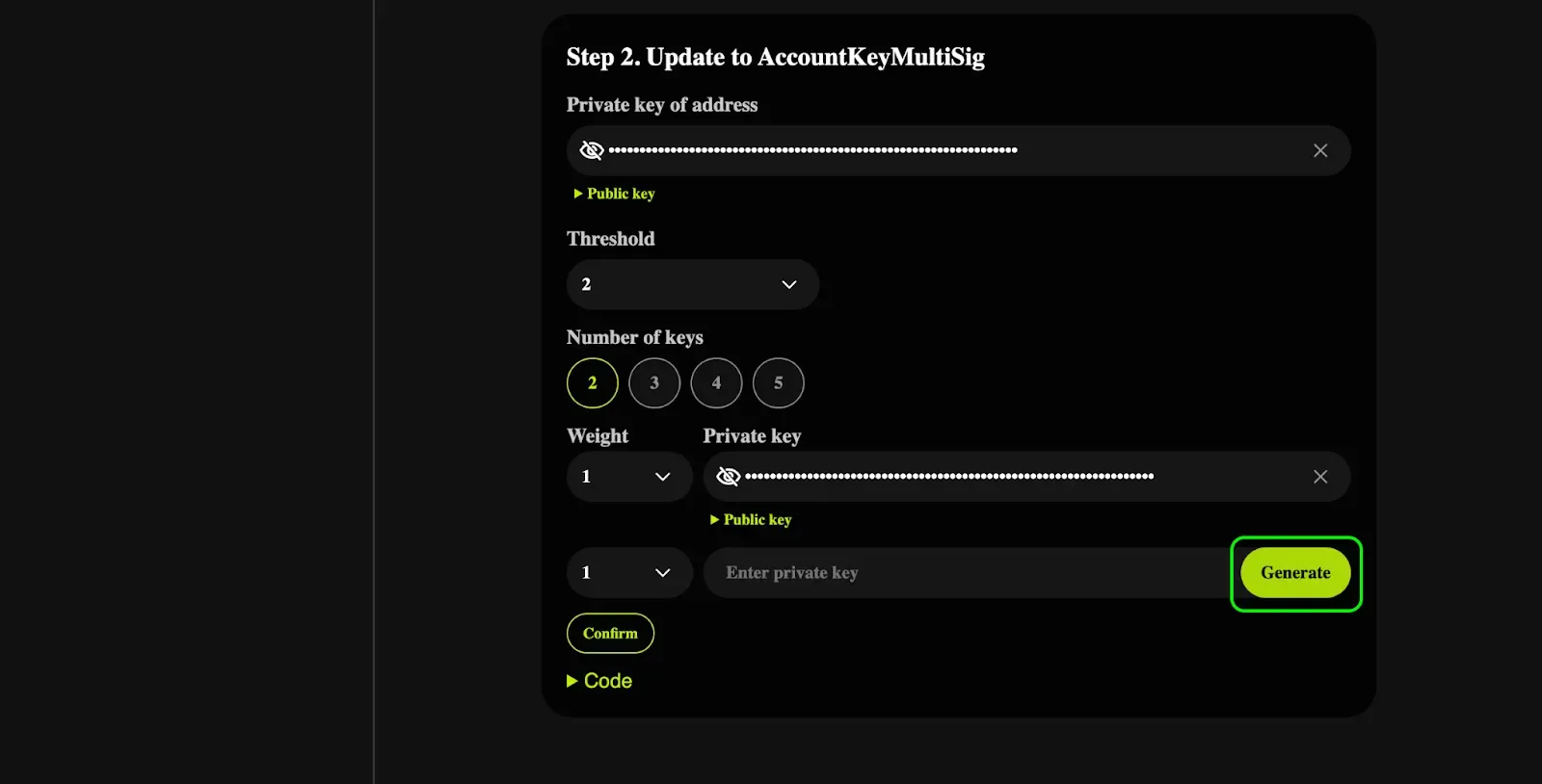
- Assign each a weight of 1.
- Set the threshold to 2.
- Click the Confirm button to broadcast the update onchain.
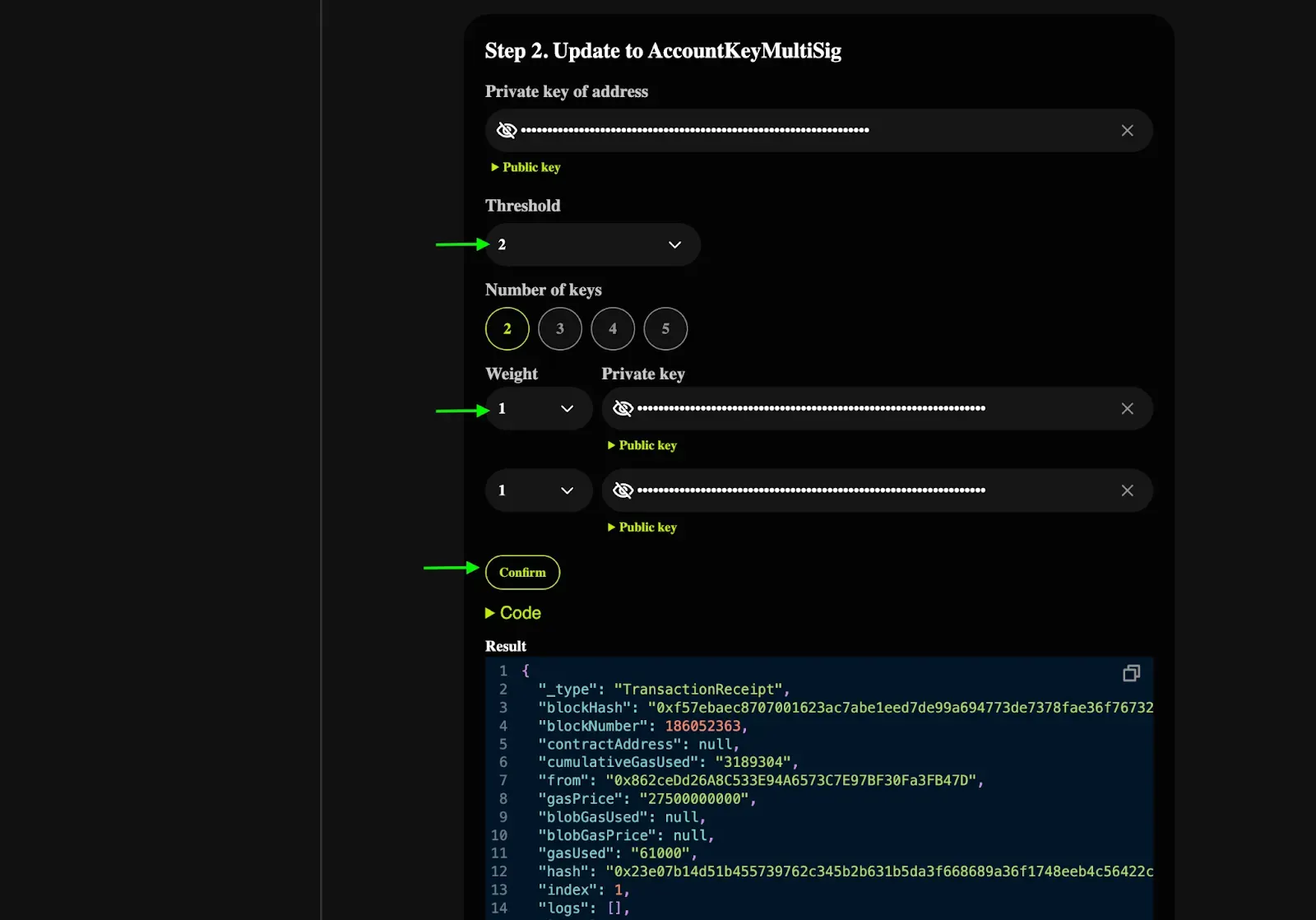
Once the update is confirmed, the account will be upgraded to use platform-level multisig. You can verify the transaction by copying the transaction hash and pasting it into Kaiascan.
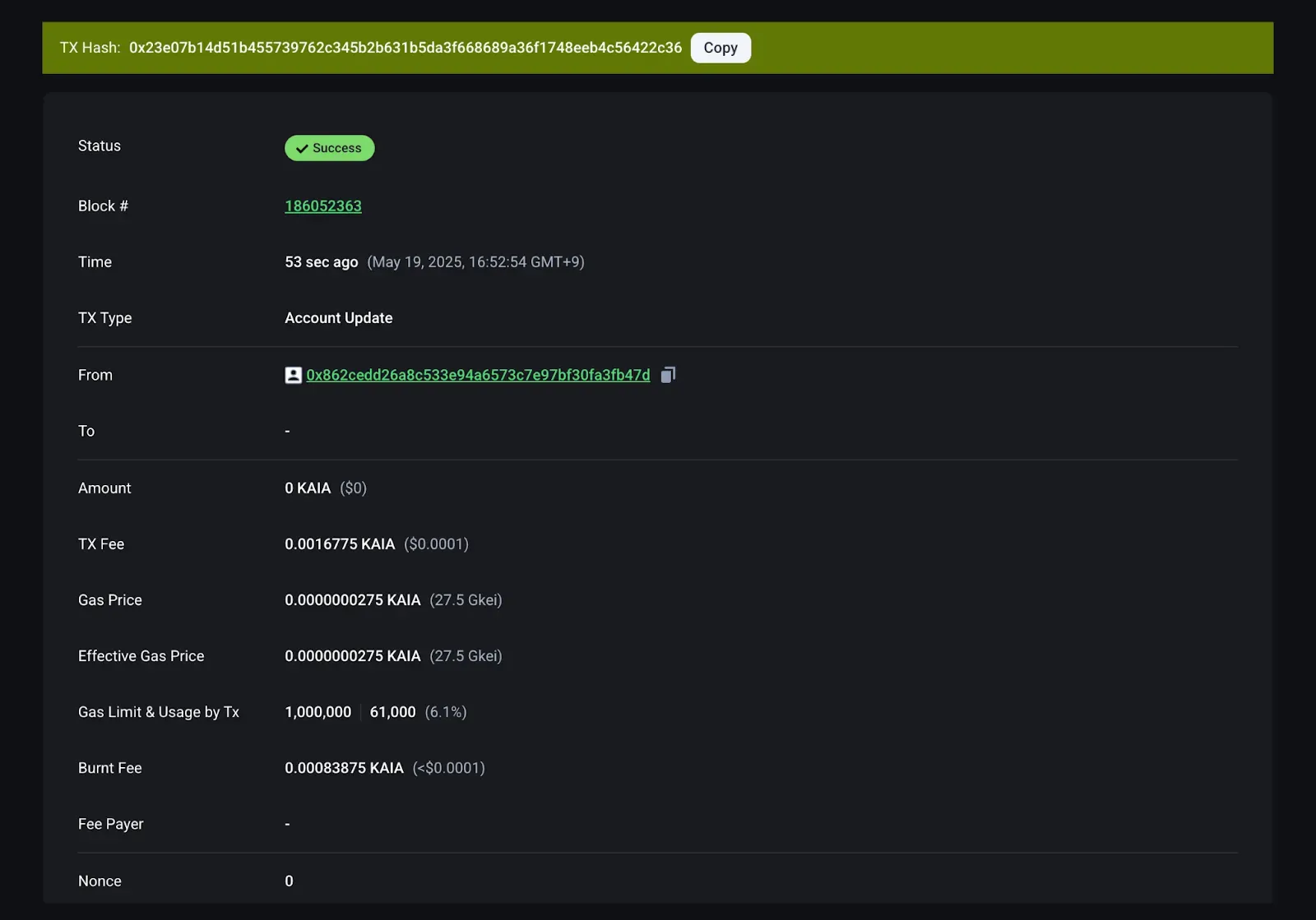
Step 4: Send Multisig Transaction
Now that we have updated our account to use multisig keys, we will use it to send KAIA. The transaction will succeed only if the weights of the private keys are equal to or exceed the threshold.
To perform a multisig native token transfer transaction, follow the steps below:
- Paste your recipient address in the recipient address field
- Add the amount of KAIA you want to transfer in the amount field
- Sign the transaction using the two keys associated with the account.
- Click confirm to broadcast the transaction on the blockchain
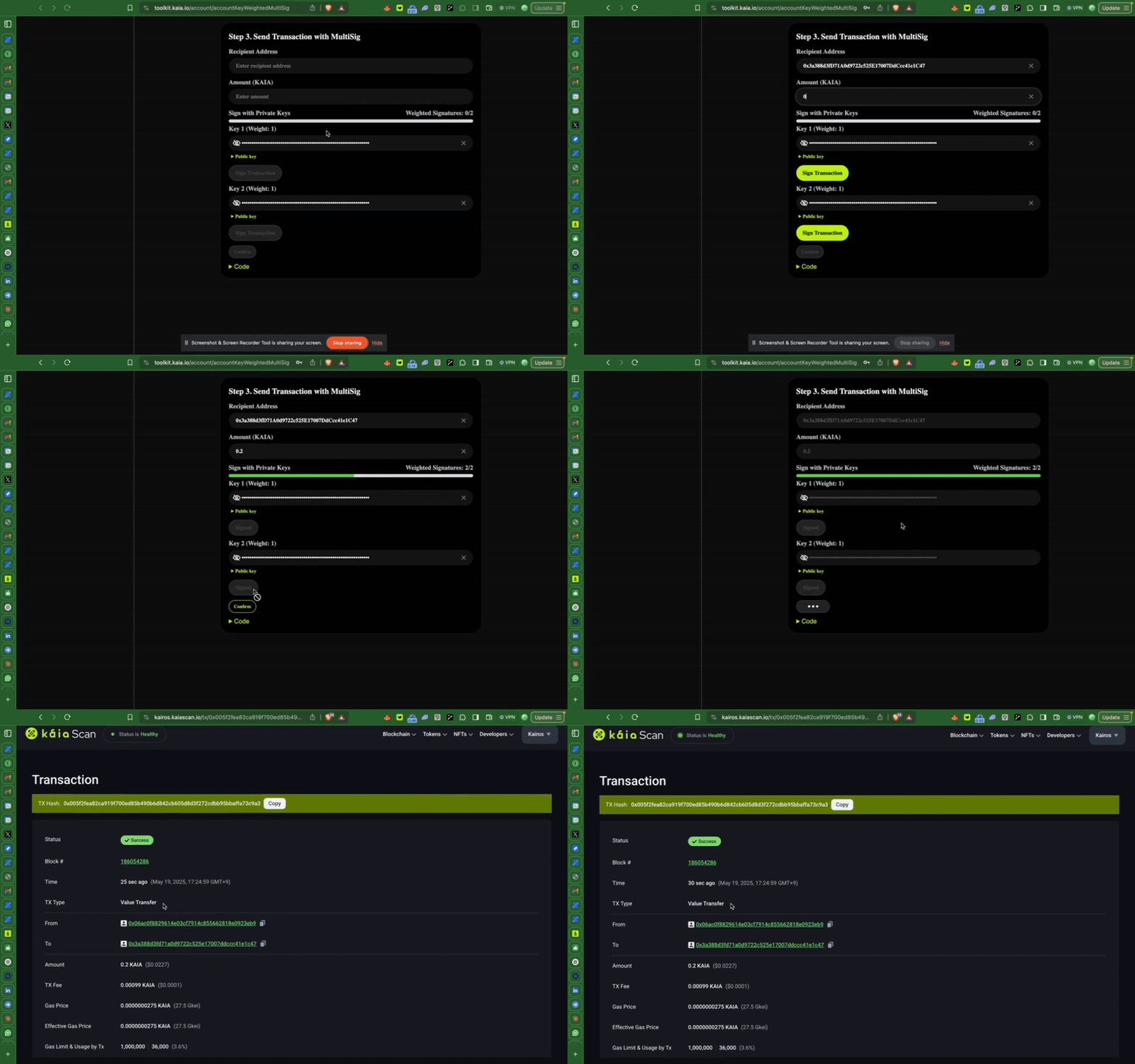
After it is processed, you will see the transaction result along with the transaction hash. You can verify the transaction by copying the transaction hash and pasting it into Kaiascan.
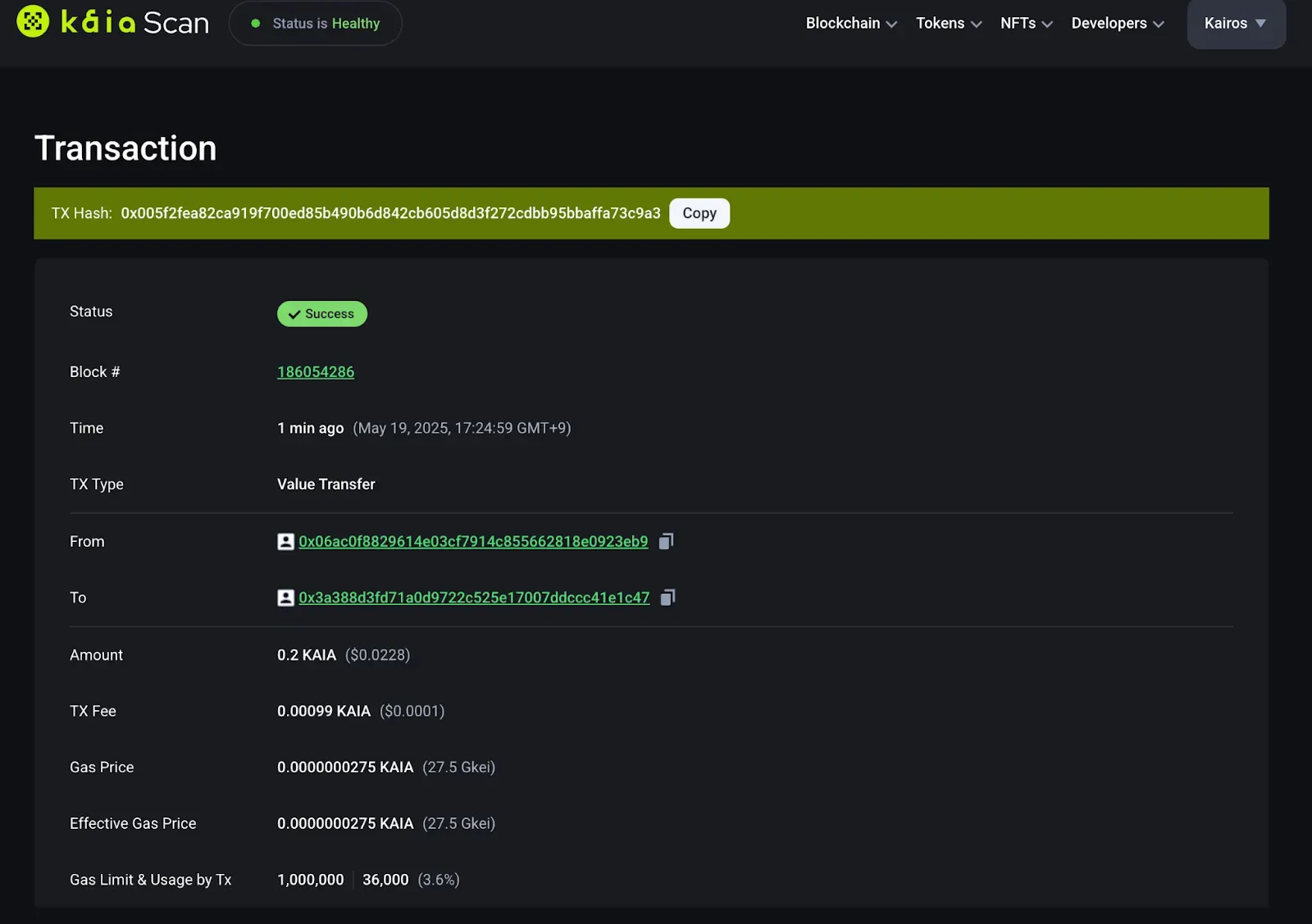
Conclusion
Platform-level multisig on Kaia is not just an enhancement — it is a reimagination of account security and user experience at the protocol layer. By decoupling keys from account addresses, Kaia enables users to rotate and update compromised keys without sacrificing their account identity. This is a monumental shift from the limitations of traditional blockchains, where a single lost or exposed key can mean the loss of an entire account.
More importantly, Kaia’s native support for AccountKeyWeightedMultisig offers an elegant alternative to smart contract-based multisig solutions. Users no longer need to worry about contract deployment, gas inefficiencies, or technical complexity. With the Kaia Toolkit and SDKs, developers can easily create robust multisig accounts, customize signing thresholds, and execute secure transactions — all while staying close to the chain’s core architecture.
This approach bridges security, usability, and developer accessibility in a way few Layer 1 platforms have attempted. Whether you are building enterprise-grade applications or personal wallets, Kaia’s platform-level multisig equips you with a powerful tool to protect user assets and ensure operational continuity.